You have felt it your whole life. The person you are at work is not the person you are with your closest friends. The person you are when you are afraid is not the person you are when you are confident. The version of you that exists in your own memory is not the version that exists in other people's. This is not inconsistency. This is not weakness. This is the documented, neuroscientifically verified structure of human identity.
For centuries, philosophy asked "who am I?" as though the answer were singular — one true self hidden beneath the noise of daily life, waiting to be discovered. Neuroscience, psychology, and philosophy of mind have now converged on a very different answer. There is no single true self. There are multiple selves, each real, each functional, each serving a specific purpose — and the experience of being "you" is the felt sense of all of them operating simultaneously. You are not confused. You are plural. And you always have been.
The 4 Selves · Verified Science
The Four Versions of You That Exist Right Now
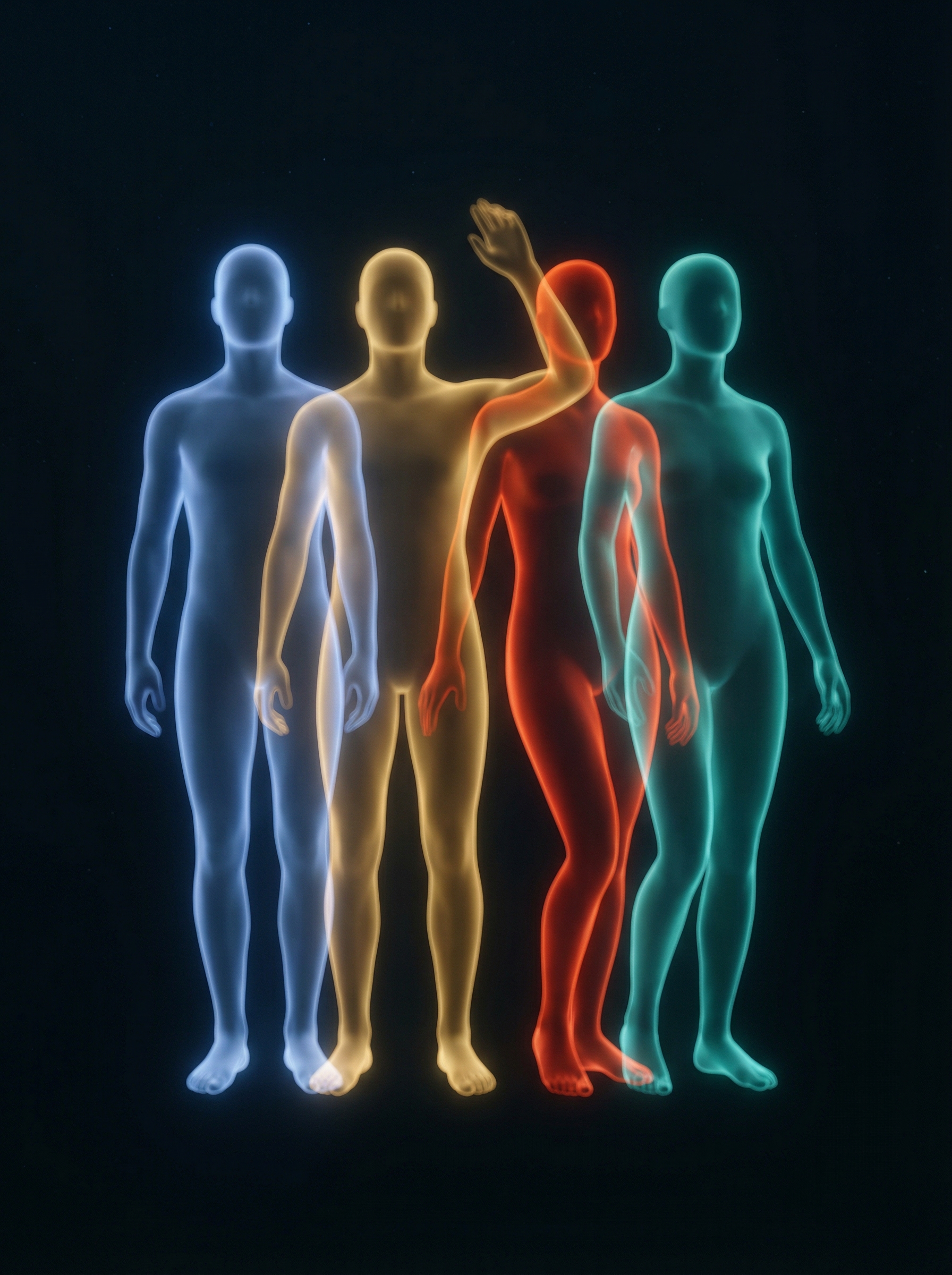
Four Selves · One Body · One Name · All of Them Real · All of Them You
01
Narrative Self
The Story You Tell About You
The self that lives in your autobiography — the continuous story of who you are, where you came from, and where you are going. Neuroscientist Antonio Damasio calls this the "autobiographical self" — constructed in the prefrontal cortex from memories, beliefs, and the stories others have told about you. It is the self that says "I." But it is a story, not a recording — and it changes every time you tell it.
02
Social Self
The Person Others See
William James, the father of American psychology, observed in 1890 that "a man has as many social selves as there are individuals who recognise him." The person you are with your mother is measurably different — in vocabulary, posture, emotional range, and opinion — from the person you are with your closest friend, your employer, or a stranger. Each is fully real. None is the complete truth.
03
Shadow Self
The Parts You Hide From Yourself
Carl Jung documented what he called the "shadow" — the collection of traits, desires, fears, and capacities that you have disowned because they conflict with your self-image or were rejected in childhood. The shadow does not disappear when you hide it. It operates unconsciously — driving inexplicable reactions, projections onto others, and the moments when you act in ways that surprise even yourself.
04
Biological Self
The Body That Runs Below Thought
Before any conscious thought, before any narrative or social performance, there is a biological self — the body's continuous tracking of its own internal state: hunger, fear, desire, fatigue, arousal. Neuroscientist Antonio Damasio proved that this biological self generates the emotional signals that unconsciously guide almost all decisions — long before conscious reasoning is consulted. The self you think is making your choices is often the last to know.
95%
of Your Decisions Are Made Before You Are Conscious of Them
Research by neuroscientist Benjamin Libet — confirmed in multiple subsequent studies — showed that brain activity associated with a decision begins up to 10 seconds before the person consciously feels they have decided. Your biological self chooses. Your narrative self writes the explanation afterward. The story of "you" deciding is constructed after the fact.
Chapter 02 · The Narrative Self
The Story You Call "Me" Is Being Rewritten Constantly
Of the four selves, the narrative self is the most familiar — and the most deceptive. It is the running internal monologue that says "I am a person who does this and not that, who has been through this and not that, who believes this and not that." It feels like a factual report. It is a creative work.
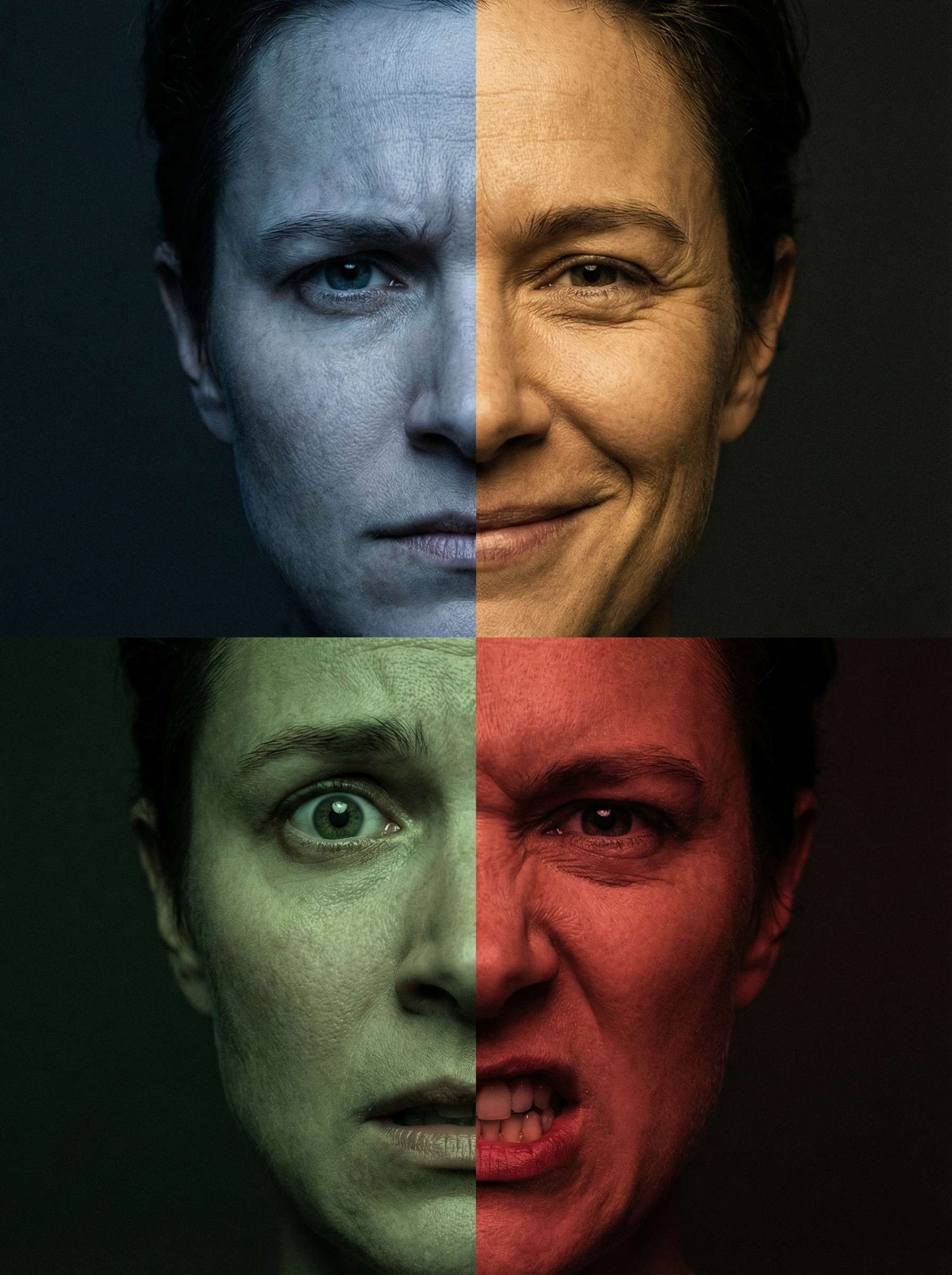
One Face · Four Selves · Four Realities · All Simultaneously True
The narrative self edits continuously — removing memories that contradict the current story, reinterpreting past events through the lens of who you are now, and constructing a sense of continuity and coherence across experiences that were often fragmented and contradictory in the moment. The person you were at fifteen and the person you are today are connected by a story, not by the same collection of cells, beliefs, or values. Almost none of those have survived intact. The narrative self is the thread that makes them feel like one person.
🔬 The Split-Brain Research
Nobel Prize-winning neuroscientist Michael Gazzaniga's split-brain research revealed what he called the "interpreter" — a module in the left brain hemisphere that generates explanations for behaviour driven by the right hemisphere, of which the left is unaware. When patients with severed corpus callosa acted on impulses from their right brain, their left brain immediately invented plausible explanations — confidently, fluently, and completely incorrectly. Your brain is narrating a story about you that it did not fully write.
Chapter 03 · The Shadow Self
The Self You Pretend Does Not Exist

The Shadow Self · What You Hide From Yourself · Controls More Than You Know
Carl Jung spent forty years documenting the shadow — the unconscious repository of everything you have decided is not "you." The anger you were told was unacceptable. The ambition you were taught was selfish. The fear you decided was weakness. The desires that conflict with your self-image. None of these disappear when you repress them. They go underground, into the shadow, where they operate without your oversight.
The shadow reveals itself in specific, recognisable patterns. The traits that irritate you most intensely in other people are often the shadow's way of showing you what you have disowned in yourself. The strongest emotional reactions — disproportionate anger, inexplicable jealousy, sudden contempt — frequently trace back to shadow material that has been triggered. The parts of yourself you judge most harshly in others are often the parts of yourself you have most thoroughly refused to see. Jung's insight was not that the shadow is evil — it is that refusing to acknowledge it is what makes it dangerous.
"Until you make the unconscious conscious, it will direct your life and you will call it fate."
— Carl Gustav Jung · Psychiatrist and Founder of Analytical Psychology
Chapter 04 · Integration
The Question Is Not Which One Is Real — They All Are

Four Reflections · One Mirror · The Question Is Not Which Is Real · All Are
The discomfort people feel when confronted with their plurality usually comes from a belief that only one self can be authentic — that if you are different with different people, one of those versions must be false. This belief is not supported by the science. Every version of you is real. The social self you present to your employer draws on genuine capacities. The person you are with your closest friends is genuine. The shadow you have buried is genuinely part of you. The biological self making decisions before consciousness arrives is genuinely driving your life.
The narrative self needs editing, not protecting. Your autobiography is a working draft, not a final document. The most psychologically healthy people are those who can revise their self-story — who can say "I was wrong about that," "I have changed," "that is not who I want to be anymore" — without feeling that revision threatens their existence.
The social self is not hypocrisy — it is range. Being different with different people is not dishonesty. It is the natural expression of different aspects of a complex self in different relational contexts. The problem is not having multiple social selves — it is when one of them becomes so dominant that the others are crowded out.
The shadow needs witnessing, not warfare. You cannot eliminate shadow material — you can only refuse to look at it, which gives it more power. The practice of acknowledging what you have buried — not necessarily acting on it, but recognising it as part of you — is what reduces its unconscious influence over your decisions.
The biological self knows things your narrative self does not. The body's signals — discomfort, fatigue, excitement, dread — are information, not noise. The narrative self often overrides biological signals with logical arguments ("I should not be afraid of this") — and is frequently wrong. The body has been tracking threat and opportunity for millions of years. It has data your story does not.
The Truth
The question "who am I really?" assumes there is a single true answer — a core self beneath all the others, more authentic than the rest. The science suggests something more interesting and more liberating: all of them are you. The story you tell, the faces you show, the parts you hide, the body that decides before you think — all of it is genuinely, entirely, irreducibly you. The work of a human life is not finding the one true self. It is learning to know all of them.
Human Confessions · hezhinx Series
EP.06 · Now
You Are Not One Person