📚
Cognitive Neuroscience & Digital Brain Research Editorial
MARK · WOLF · SPITZER · GAZZALEY · CARR · SMALL · UC IRVINE · UCLA · MIT · PEER-REVIEWED
⏱ 14 min read
#AttentionCrisis
#DigitalBrain
#CantFocus
#ReadingBrain
#DigitalDementia
#AttentionSpan
#GloriaMark
#MaryAnneWolf
#BrainScience2026
47sec
Average Human Attention Span on Any Screen — 2024. It Was 2.5 Minutes in 2004. It Has Fallen 68% in 20 Years. This Is Not Normal. This Is Measurable Brain Architecture Change.
Gloria Mark · University of California Irvine · "Attention Span" 2023 · Peer-reviewed study of 276 workers · Continuous measurement since 2004 · Published Cambridge University Press
Here is a test. Read the next paragraph without looking at anything else. No phone, no other tab, no glancing up. Just read.
How did that go? If your mind wandered before you finished, if some part of you wanted to check something, if the act of reading a few sentences felt like more effort than it used to — you are experiencing exactly what this article is about. Your attention has been architecturally altered. Not temporarily, the way fatigue alters attention. Structurally — the way repeated use of any neural system alters the brain's physical organisation and functional priorities.
The research that explains this is not new. It has been accumulating since 2004, when cognitive scientist Gloria Mark at UC Irvine first began the longest continuous measurement of human attention on digital devices ever conducted. What she found then was disturbing. What she is finding now — twenty years later — is significantly worse. And the implications for what is happening to an entire generation's cognitive capacity are serious enough that she published them in a book called "Attention Span" in 2023, which opened with the sentence: "We are in an attention crisis."

🖼️Search: "person trying read book frustrated cannot focus"
THE READING BRAIN The neural circuits required for deep reading — sustained attention, inference, background knowledge activation, analogical reasoning, critical reflection — took years to build through practice. They can be dismantled by disuse faster than they were built. Maryanne Wolf: "We are not born with a reading brain. We build it. And what we build, we can lose."
Discovery 01 — The 47-Second Brain
In 2004 Your Attention on a Screen Lasted 2.5 Minutes. In 2024 It Lasts 47 Seconds. This Happened Inside One Human Generation.
01
⏱ Prof. Gloria Mark · UC Irvine · 20-Year Attention Study · 2023
The Longest Study of Human Attention on Digital Devices Ever Conducted — 20 Years, Hundreds of Workers — Found That Average Focused Attention Has Fallen from 2.5 Minutes to 47 Seconds
📖 Mark G. "Attention Span: A Groundbreaking Way to Restore Balance, Happiness and Productivity." Cambridge University Press 2023 · 20-year longitudinal measurement · UC Irvine Department of Informatics
Gloria Mark began measuring human attention on computers in 2004. Her method was systematic: researchers shadowed knowledge workers throughout their day, logging every attention switch — every time a person moved from one task, screen, document, or window to another. In 2004, the average duration of focused attention on a single screen before switching was 2 minutes and 30 seconds.
She continued measuring. In 2012: 75 seconds. In 2020: 47 seconds. This is not a subtle decline. This is a 68% reduction in the average duration of focused human attention in twenty years — within a single generation, without any genetic change, without any neurological disease. Something in the environment changed human cognitive function at scale. The something is clear in the data: the introduction and normalisation of smartphone technology, always-on connectivity, and notification-driven digital environments.
The additional finding that makes this alarming rather than merely interesting: each attention switch costs the brain a measurable cognitive tax. Mark's research found that after switching attention — even briefly — it takes an average of 23 minutes to return to deep, uninterrupted focus on the original task. At 47-second attention durations, the brain is never getting there. It is spending its entire working day in a permanent state of shallow, fragmented attention — never reaching the depth at which complex thinking, creative synthesis, and genuine understanding actually occur. And the brain, as a prediction machine, adapts: it begins to treat fragmented attention as the norm, and sustained focus as the anomaly. The capacity for depth atrophies through disuse.
"We are in an attention crisis. The way we are using digital media is changing not just how we focus — it is changing who we are. Our ability to sustain attention, to concentrate, to think deeply — these are not fixed traits. They are skills that are built through practice, and they are being dismantled through disuse, at a speed and scale we have never seen before in human history."
— Prof. Gloria Mark PhD · Department of Informatics · University of California Irvine · Author, Attention Span · 20 years of continuous attention measurement
23min
To Return to Deep Focus After One Interruption
Gloria Mark · UC Irvine · Continuous measurement data
77×
Per Day Average Phone Checks — US Adults 2024
Asurion annual smartphone habits research · 2024
6yr
Average Age First Smartphone — Children in 2026
Common Sense Media · US Digital Health report 2024
200%
Rise in ADHD Diagnoses Since Smartphone Mass Adoption
CDC ADHD prevalence data · Twenge JM correlation analysis 2023
02
📖 Prof. Maryanne Wolf · UCLA · "Reader, Come Home" · 2018 / Proust and the Squid 2007
The Reading Brain Is Not Natural — It Was Built by Civilisation Over Thousands of Years. It Can Be Dismantled by a Decade of Scrolling. And Most Adults Are Already Losing It.
📖 Wolf M. "Reader, Come Home: The Reading Brain in a Digital World." HarperCollins 2018 · Cognitive neuroscience of reading · UCLA Distinguished Professor
Maryanne Wolf is a cognitive neuroscientist and one of the world's leading authorities on the brain science of reading. Her central insight is one that should be taught in every school but is almost unknown outside specialist circles: the human brain was not born to read. Reading is not an innate capacity like language. It is a learned technology — one of the most cognitively complex things a human brain has ever been asked to do.
When a child learns to read, they are literally constructing new neural circuitry — building connections between visual processing regions, language regions, memory systems, and executive function networks that do not exist at birth. This process takes years. The resulting neural architecture — what Wolf calls the "reading brain" or the "reading circuit" — is the biological substrate not just of literacy, but of all the complex thinking that literacy enables: inference, empathy, analogical reasoning, critical analysis, and the capacity to hold a complex idea long enough to examine it from multiple angles.
Wolf's alarm — expressed in "Reader, Come Home" — is precisely calibrated: the reading circuit, because it is learned and not innate, requires continuous practice to maintain. And the digital reading environment — characterised by skimming, scanning, hyperlink-following, and the absence of sustained linear engagement — is not just failing to maintain the reading circuit. It is actively replacing it with a different, shallower circuit optimised for rapid information extraction rather than deep comprehension.
In a passage from "Reader, Come Home" that has been widely circulated, Wolf describes her own experience: "I am a reading scientist. I have studied the reading brain for 40 years. And several years ago, I found I could no longer read Hermann Hesse. I could get the words. But the patience, the depth, the willingness to sit with complexity — I had to retrain my own reading brain. What had happened to my own circuitry frightened me more than any finding in my research." If it happened to the world's leading expert on the reading brain, it is happening to everyone who has been in a similar digital environment for a similar period of time.
The Two Brains — Scrolling vs Deep Reading
These Are Not Two Different Habits. They Are Two Different Neural Architectures. And They Cannot Both Run at Full Capacity.
📚 THE DEEP READING BRAIN
Sustained attention — holds focus for minutes, hours
Deep comprehension — builds meaning across paragraphs
Inference and analogy — connects ideas across time
Critical analysis — evaluates, questions, synthesises
Empathy activation — enters other minds and perspectives
Patience with difficulty — treats complexity as reward
🖼️Search: "brain scan MRI neuroscience digital technology impact"
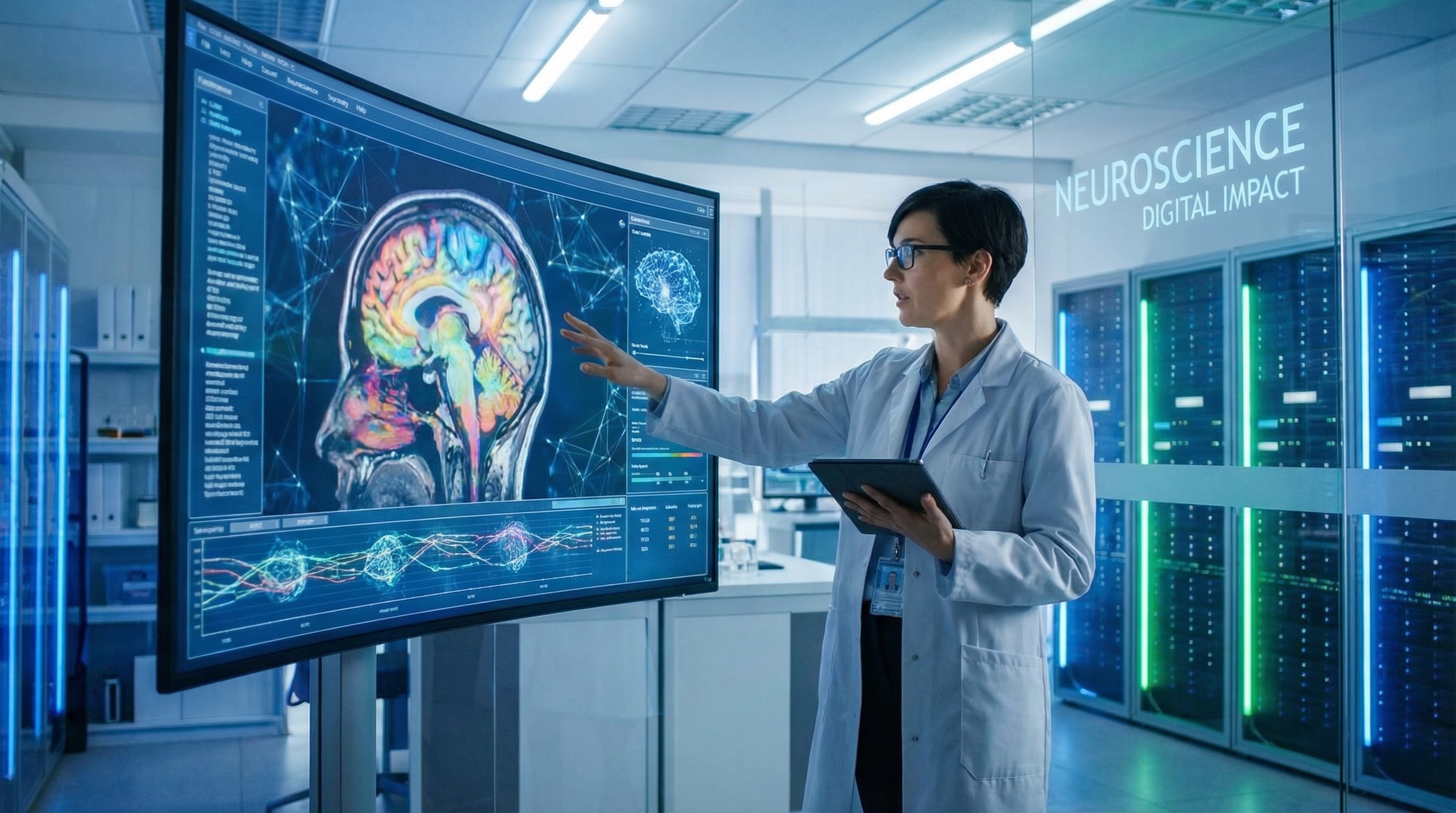
TWO CIRCUITS The neural circuit for deep reading and the circuit activated by rapid digital scrolling are functionally distinct and to some extent competitive. Dominance of one weakens the other through the brain's fundamental "use it or lose it" principle of synaptic pruning. The hours spent scrolling are not neutral time. They are active training of the shallow circuit at the expense of the deep one.
03
🧠 Prof. Manfred Spitzer · Ulm University / Gary Small · UCLA · Digital Memory Research
"Digital Dementia" — Outsourcing Memory, Navigation, and Calculation to Devices Is Shrinking the Brain Regions That Once Performed Them. This Is Not Theoretical. It Has Been Imaged.
📖 Spitzer M. "Digital Dementia." Droemer 2012 · Woollett K & Maguire EA. Current Biology 2011 (London cabbie hippocampus) · Small GW. "Your Brain on Google." PNAS 2009
The London black cab study is one of the most cited demonstrations of neuroplasticity in the scientific literature: researchers at UCL found that the hippocampi (the brain's primary spatial memory structures) of experienced London cab drivers were measurably larger than those of control subjects — and that the enlargement was specifically in the region responsible for spatial navigation. The brain grew the structure it needed because it was being used intensively. German neuroscientist Manfred Spitzer's "Digital Dementia" argument begins with the logical implication: if use grows brain structure, disuse shrinks it.
GPS navigation has replaced the need for spatial memory. Search engines have replaced the need for fact retention. Calculators have replaced the need for arithmetic fluency. Spell-checkers have replaced the need for spelling knowledge. Each of these replacements is individually reasonable and collectively devastating: the brain regions that performed these functions are no longer being asked to perform them — and neural structures that are not used are pruned, weakened, and eventually reassigned.
Gary Small at UCLA confirmed a related mechanism in a 2009 PNAS study: experienced internet users and naive internet users showed distinctly different patterns of brain activation while searching online. The experienced users showed significantly higher activation in the prefrontal cortex during search — but this activation pattern, while it looked impressive, was specifically associated with decision-making about where to click rather than deep information processing. The internet-experienced brain was optimised for navigation, not comprehension. It was getting better at finding, and worse at understanding what it found. The outsourcing of cognitive functions to devices is not improving efficiency. It is reducing capacity.
What It Looks Like In Your Daily Life
The Signs You Are Already Experiencing — and What Each One Means
📖
Can't Finish a Book Anymore
The sustained attention required to read a book — holding a narrative across multiple sessions, building meaning incrementally — is precisely the capacity that fragmented digital reading dismantles. If you used to finish books and now can't, you are experiencing reading circuit atrophy.
Wolf M · Reader Come Home · Reading circuit research
💭
Thoughts Feel Shallower
The capacity for deep, sustained, complex thought is a direct product of the deep reading circuit. As the circuit weakens, thinking becomes more associative and less analytical — you have more thoughts per minute but each goes less deep. People describe this as "feeling stupider," which is biologically accurate: the cognitive tools for depth are less available.
Carr N · The Shallows · Cognitive depth and reading research
📵
Phantom Phone Anxiety
Feeling anxious when separated from your phone, or checking it reflexively when it hasn't vibrated. This is the dopamine-seeking system adapting to a variable-ratio reinforcement schedule — the most addictive schedule known. The anxiety is real. It is the notification system having been internalised as a basic orientation mechanism.
Mark G · Gazzaley A · The Distracted Mind · 2016
🗺️
Can't Navigate Without GPS
Spatial memory atrophy from GPS dependence is measurable and confirmed. The hippocampal spatial navigation regions show reduced activation in GPS-dependent navigators compared to map-readers. You are not worse at directions because you are older. You are worse because that particular cognitive muscle has not been asked to work in years.
Spitzer M · Woollett & Maguire · Current Biology 2011
🔁
Re-Reading the Same Paragraph
Reading a passage and realising you retained nothing — so reading it again, and retaining almost nothing again. This is the reading circuit in degraded state: the words are being processed but the deeper comprehension machinery — building semantic relationships, connecting to prior knowledge — is not engaging. The shallow skimming circuit is running instead.
Wolf M · UCLA · Deep reading comprehension research
⚡
Boredom Within Seconds
An almost instantaneous boredom with tasks that offer no immediate novelty or reward — the need for constant stimulation that the scrolling brain, having been trained on infinite content feeds, now carries into all contexts. Waiting in a queue, sitting in silence, reading without reward — each becomes almost unbearable.
Mark G · Attention Span 2023 · Tolerance for boredom and digital use
📊 Interventions That Restore Cognitive Depth — Research Evidence
Daily deep reading (30min)
Directly rebuilds reading circuit
Notification-free work blocks
Enables 23min focus recovery
Navigation without GPS
Restores hippocampal activation
Handwriting over typing
Mueller & Oppenheimer — deeper encoding
Single-tasking deliberately
Rebuilds sustained attention
More scrolling / content
Accelerates circuit degradation

-->
🖼️Search: "notification phone screen anxiety attention distraction modern"
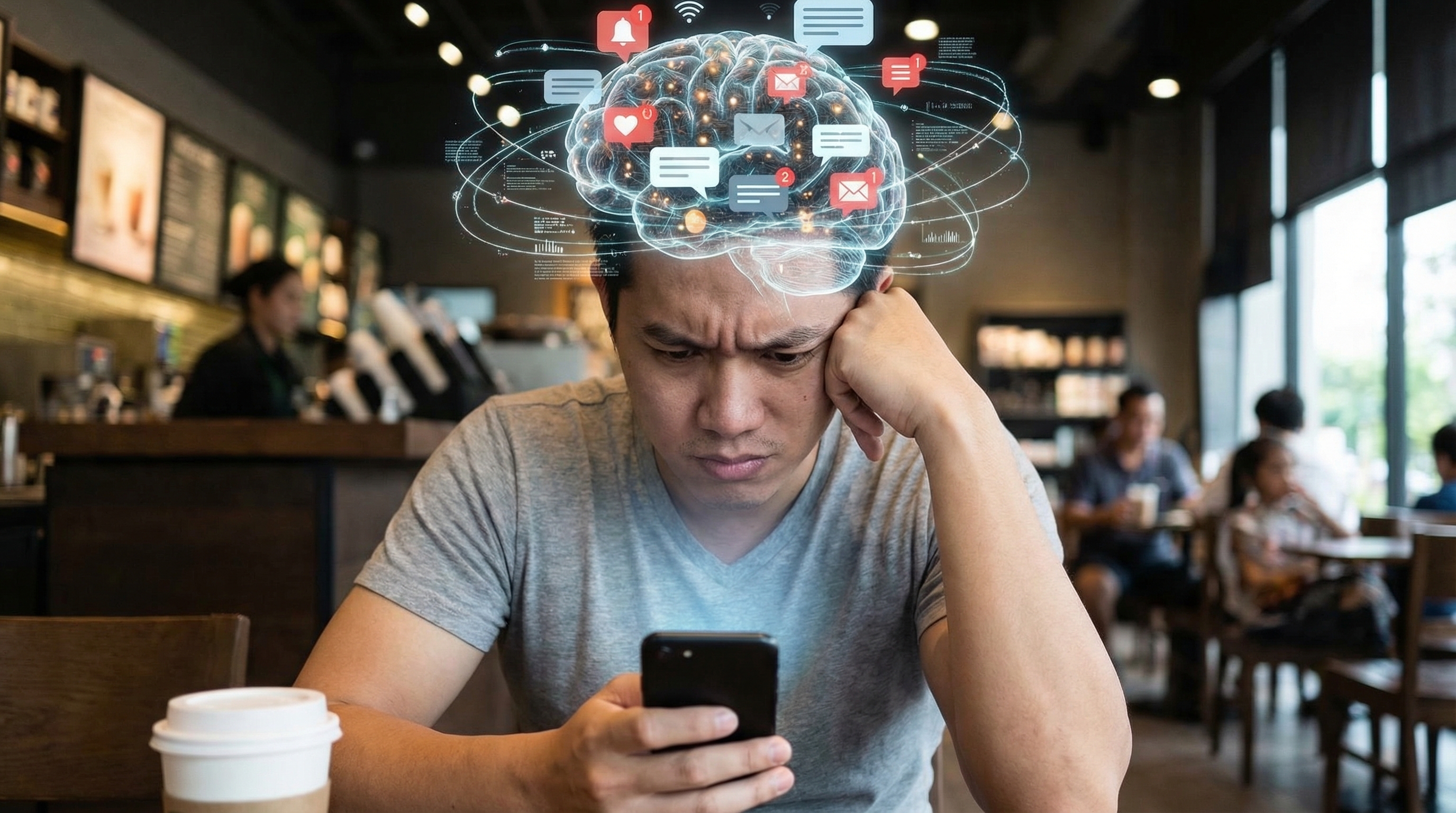
THE NOTIFICATION ARCHITECTURE The average smartphone user receives 80+ notifications per day. Each one is designed — by engineers whose careers depend on maximising engagement — to interrupt attention and generate a reward response. At 47-second average focus durations, the notification architecture is the most powerful single force shaping human cognition in 2026. It was designed to be.
04
✅ Neuroplasticity Research · Wolf · Mark · Gazzaley · 2018–2026
The Most Important Question: Is It Reversible? The Neuroscience Answer Is Yes — But It Requires the Specific Intervention That Caused the Damage in Reverse. The Brain Needs Deep Practice, Not Just Less Scrolling.
📖 Wolf M. Reader Come Home 2018 · Mark G. Attention Span 2023 · Neuroplasticity evidence for reading circuit restoration
This is the question that determines whether this article is devastating or merely alarming: can the reading brain be restored? Can the attention span be rebuilt? Can the cognitive depth that has been eroded by years of fragmented digital engagement be recovered?
The answer from neuroplasticity research is yes — with a qualification. The brain's ability to rebuild neural circuitry through practice is well-established and operates throughout the lifespan. The London cab drivers grew hippocampal tissue in their forties, fifties, and sixties. Reading circuits, once degraded, can be reconstructed. Attention, once fragmented, can be retrained. But — and this is the qualification that the self-help industry almost universally omits — the reconstruction requires the specific activity that builds the circuit. Not less scrolling. Not "digital detox" weekends. The circuit is built by deep reading. Only by deep reading.
Wolf describes her own reconditioning process: she returned to reading books — not audiobooks, not tablets with notifications enabled, but paper books — for thirty minutes per day, with her phone in another room, without interruption. The first week was uncomfortable. The second week, she noticed she could hold the text for longer. By the end of the first month, the patience was returning. By three months, she was back to reading Hermann Hesse. The brain responded to the practice. It always does. The practice has to be the right kind — sustained, linear, deep, without interruption. The precise opposite of the environment that caused the damage. That is the difficulty. And that is the answer.
📚 The Protocol — What the Research Supports
Based on convergent research from Mark, Wolf, Gazzaley, and Spitzer, there are four specific practices that rebuild the cognitive capacities the digital environment is dismantling. First: 30 minutes of paper-book reading per day, phone in another room, no interruptions. This is the primary practice for rebuilding the reading circuit. Not e-books (backlit, notification-capable), not articles (too short), not audiobooks (passive). Paper books, held without interruption. Second: designated notification-free work blocks of 90 minutes minimum. Mark's research shows 23 minutes to return to deep focus after an interruption — at 47-second attention durations, most people never get there. A 90-minute notification-free block is the minimum unit of genuine cognitive work. Third: deliberate boredom — 10 minutes per day of doing nothing. No phone, no music, no stimulation. The discomfort this produces is the sensation of the novelty-seeking system finding no food. Sitting with that discomfort is how the tolerance for depth is rebuilt. Fourth: one weekly navigation exercise without GPS. This is not about directions. It is about keeping the hippocampal spatial memory system engaged with a real cognitive challenge. These four practices are not lifestyle choices. They are neural maintenance. The brain that does them will be measurably different from the brain that doesn't — and the difference will be apparent within weeks.
Mark G 2023 · Wolf M 2018 · Gazzaley A 2016 · Spitzer M 2012 · Mueller & Oppenheimer 2014 · All peer-reviewed
THE RECONSTRUCTION Maryanne Wolf spent three months deliberately re-reading, starting with 30 minutes per day of paper books, to rebuild her own reading circuit after years of digital immersion. The brain responded. It always responds to practice. The reading brain that built civilisation is still buildable. The question is whether you will give it the practice it requires.
The Last Word
The Slowness You Are Feeling Is Not Who You Are. It Is What the Environment Has Done to a Brain That Was Built for Depth.
The feeling you came to this article with — the sense that your mind is slower than it was, shallower, less able to sustain the kind of thinking you remember being capable of — is not ageing, and it is not a character flaw. It is the measurable, documented result of spending years in an environment whose architecture was designed, with extraordinary sophistication and enormous financial incentive, to fragment your attention at 47-second intervals, to reward novelty-seeking over depth, to make the effort of sustained focus feel excessive — and to do all of this so gradually, so naturally embedded in the tools of modern life, that it felt like the new normal rather than a transformation.
It was a transformation. It is documented. And it is, in the most important sense, reversible — because the brain that was changed by an environment can be changed again by a different one. The reading circuit that built humanity's greatest capacities for thought, empathy, and understanding is not gone. It is dormant. It is waiting for the practice that will rebuild it.
Pick up a book. Put your phone in another room. Give it thirty minutes. The first week will be uncomfortable — that discomfort is the atrophied circuit being asked to engage. By the second week, something will shift. By the second month, you will not recognise the difference in how you think. Your brain was built for this. It remembers. It just needs you to remember first.
#YourBrainIsBeingRewritten
#ReadingBrain
#AttentionCrisis
#GloriaMark
#PickUpABook
#DeepWork
#ShareWithEveryoneYouKnow