Every year, humanity produces 2.3 billion tonnes of municipal solid waste. By 2050, that number reaches 3.8 billion tonnes. The vast majority of it is buried in landfills — where it generates methane, contaminates groundwater, destroys land, and produces a debt of environmental damage that accumulates for centuries. And inside every tonne of that buried garbage is the raw material for fertiliser, electricity, clean fuel, building materials, and carbon credits — worth more than the cost of collecting and processing the garbage in the first place.
This is not a future technology problem. The individual processes that can convert waste into valuable outputs — pyrolysis, gasification, anaerobic digestion, plasma arc processing, hydrothermal carbonisation — all exist, all work at commercial scale, and all have been deployed in isolation around the world. What does not exist is a single integrated system that combines all of them, accepts any waste as input, and produces the full range of valuable outputs simultaneously. The machine that eats everything and produces everything has not been built. This is the business.
The System
Input → Process → Everything
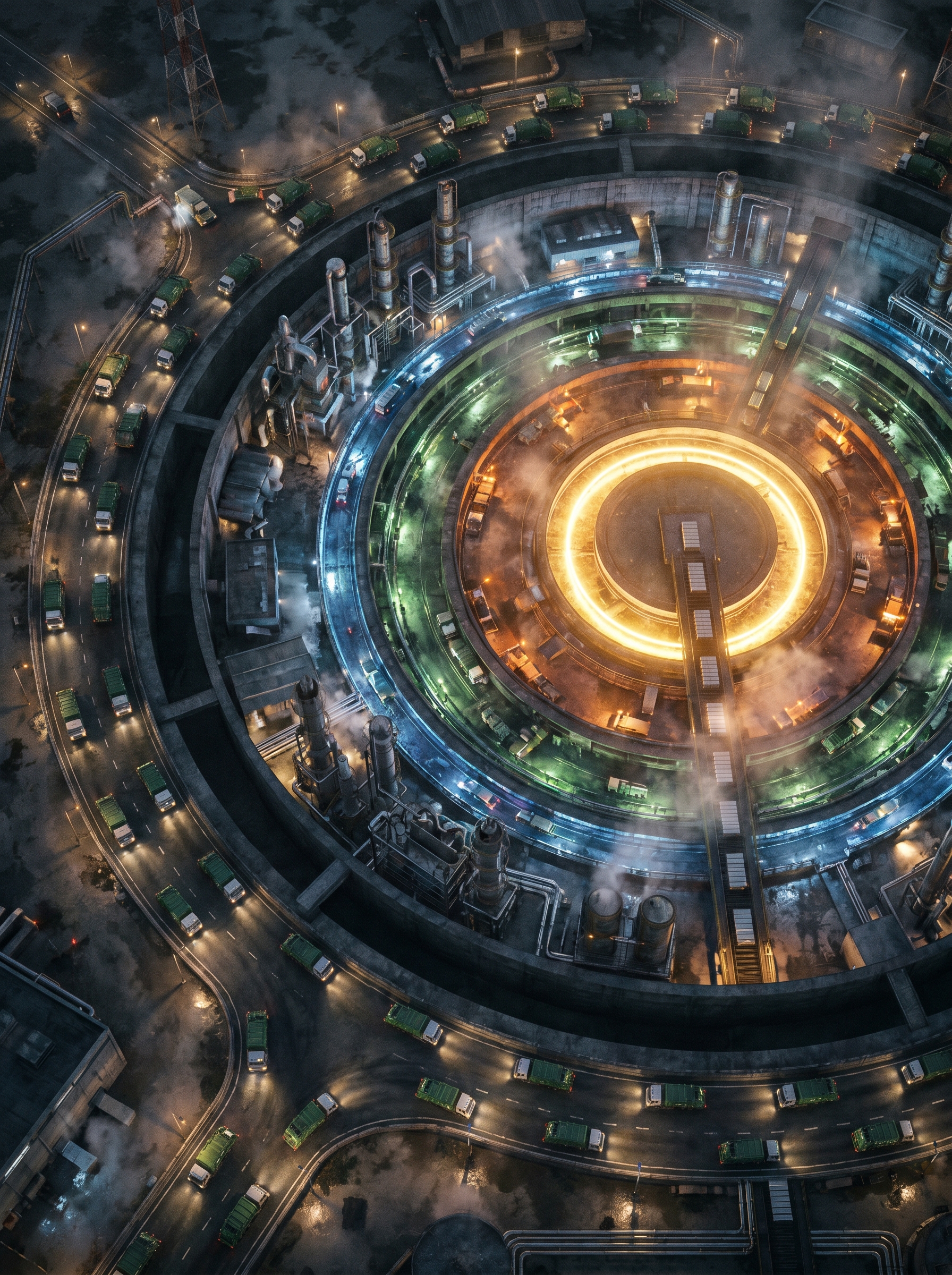
Garbage In · From Every Side · Processed Through Every Stage · Products Out · The Facility Nobody Has Built
♻️ Universal Waste Conversion — Full System Flow
→
Stage 1
AI Sort + Separate
Organics
Food · Wood · Paper
→
Pyrolysis
Biochar + Syngas
→
Gasification
Fuel Gas + Electricity
→
Hydrothermal
Clean Water + Biogas
→
Compression
Building Panels
Every output from one stage becomes either a finished product or an input to the next stage. Nothing leaves the system as waste. The system eats waste and produces only things people want to buy. The inputs are free — municipalities pay to have garbage collected. The business model is one of the most extraordinary in industrial history: you get paid to receive your raw material, and then paid again for everything you produce from it.
The Outputs
7 Products From One Input
🧱Building Panels
$80–200/m²
💧Clean Water
Municipality sale
🔩Recycled Metal
Market price
💰Carbon Credits
$100–200/tonne
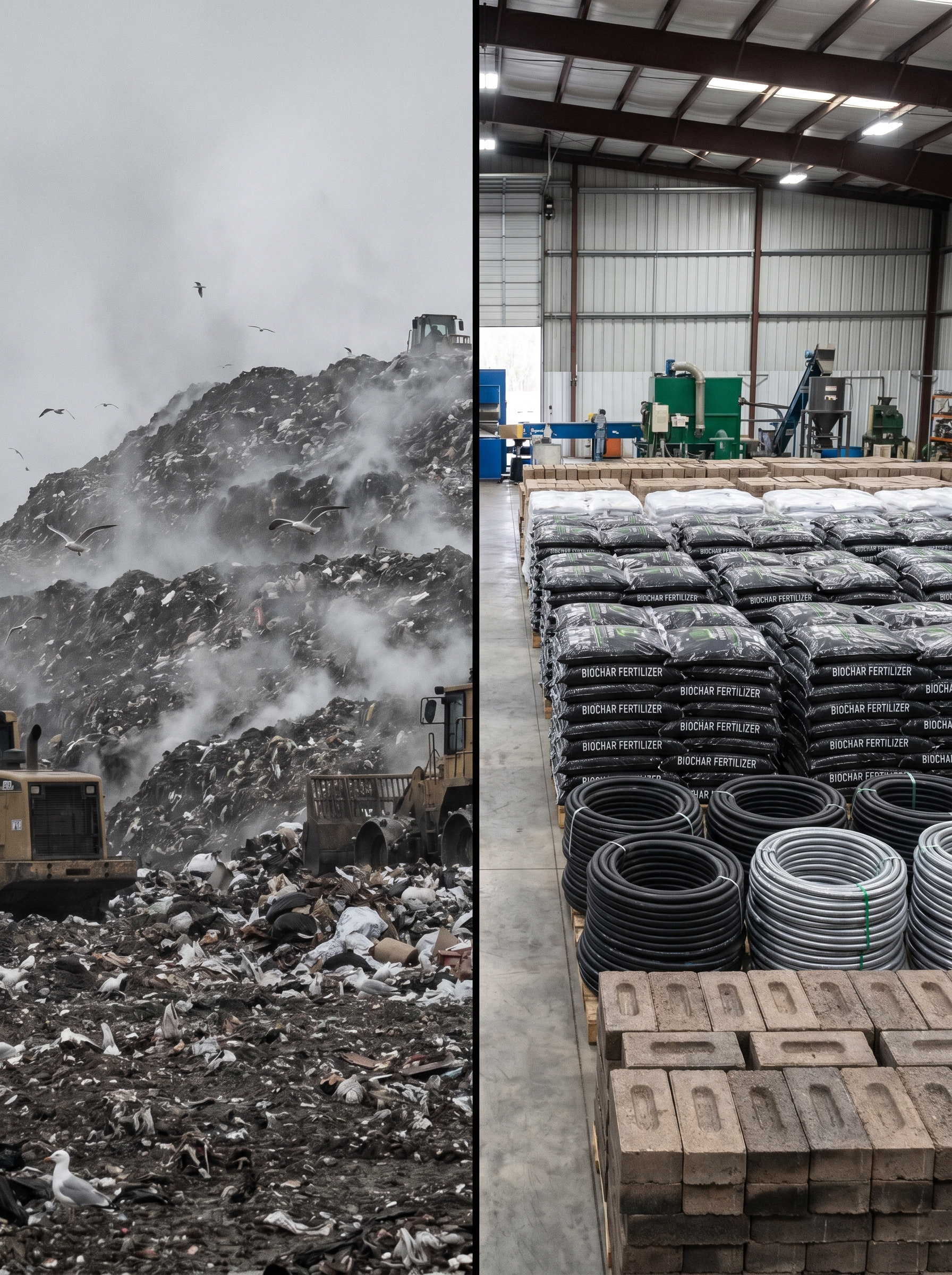
Same Material · Left: Buried as Problem · Right: Sold as Solution · The Only Difference Is the Machine
Chapter 01 · The Science
How Each Process Actually Works
🔥
Pyrolysis · Proven
Heating Waste Without Oxygen — The Core Technology
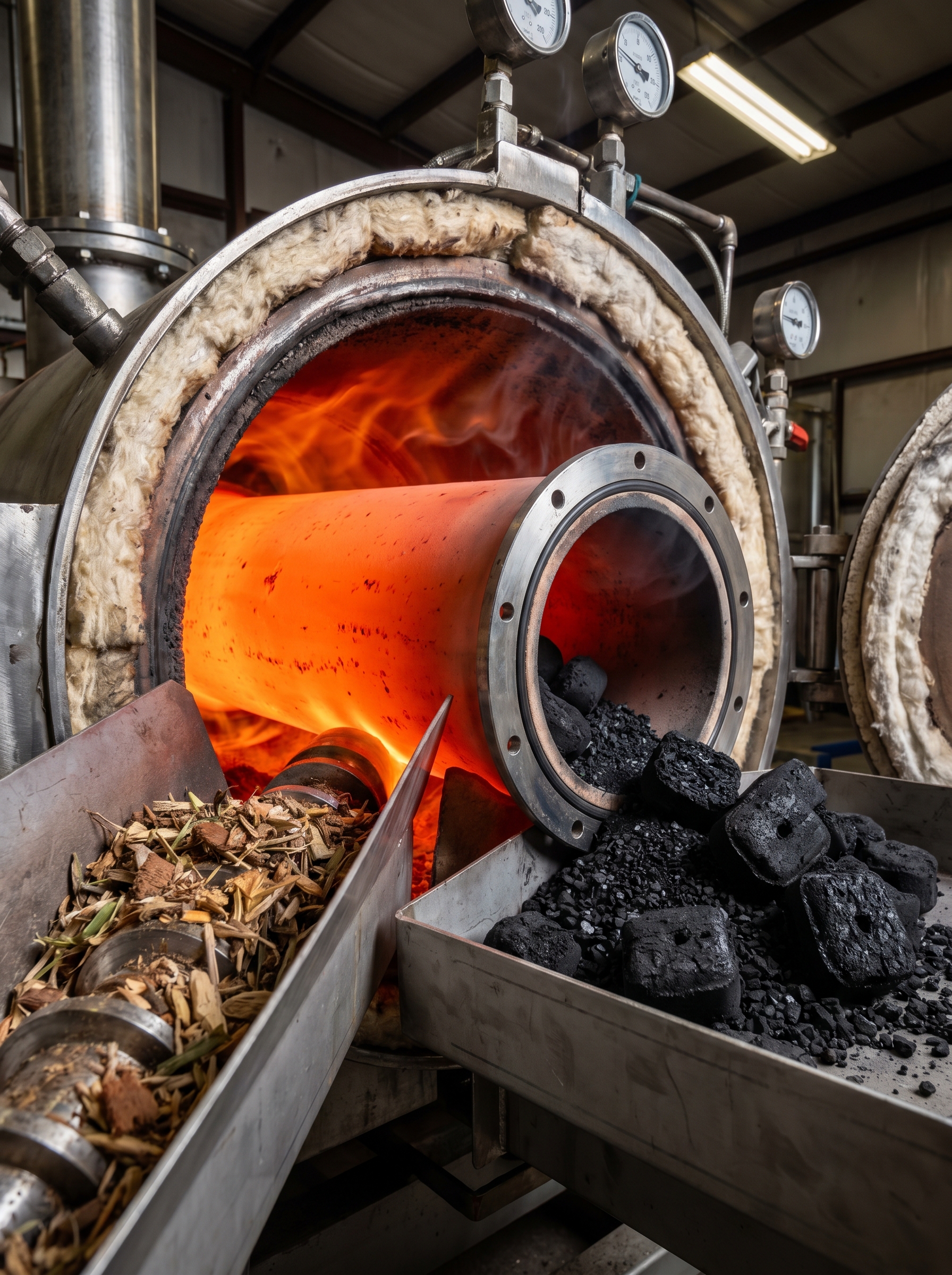
Pyrolysis heats organic material to 400–700°C in the absence of oxygen — preventing combustion while breaking molecular bonds. Output: biochar (solid carbon), syngas (combustible gas), and bio-oil. The biochar is a premium soil amendment. The syngas powers the facility itself and generates surplus electricity. Commercially proven at scale in Europe, Japan, and Australia.
⚗️
Gasification · Proven
Converting Plastics to Clean Fuel at High Temperature
Gasification converts carbon-based materials — including all plastic types — into synthesis gas (hydrogen + carbon monoxide) at 700–1,200°C. The syngas can be burned directly for electricity, converted to hydrogen fuel, or processed into liquid fuel. Plasma arc gasification handles even hazardous waste. Zero landfill residue. Multiple commercial plants operating globally.
💧
Hydrothermal · Proven
Wet Waste Converted to Clean Water and Biogas
Hydrothermal carbonisation processes wet organic waste — food waste, sewage sludge, agricultural residue — at 180–250°C under pressure. Output: hydrochar (similar to coal), clean water, and biogas. Unlike pyrolysis, no drying of feedstock required. The clean water meets potable standards after additional filtration. Multiple demonstration plants operating in Germany and Denmark.
🧱
Geopolymer · Emerging
Ash and Slag into Structural Building Materials
Processing residues — ash, slag, inert materials — are combined with alkali activators to produce geopolymer concrete: a building material with comparable or superior strength to Portland cement, produced entirely from waste, with 80% lower CO₂ emissions. The building panel market is actively seeking certified recycled-content materials. Supply is the bottleneck — not demand.
Chapter 02 · The Proof
What Biochar Does to Agricultural Land
Waste In · Orange Heat · Zero Oxygen · Black Biochar Out · The Transformation · Proven · Commercial · Available Now
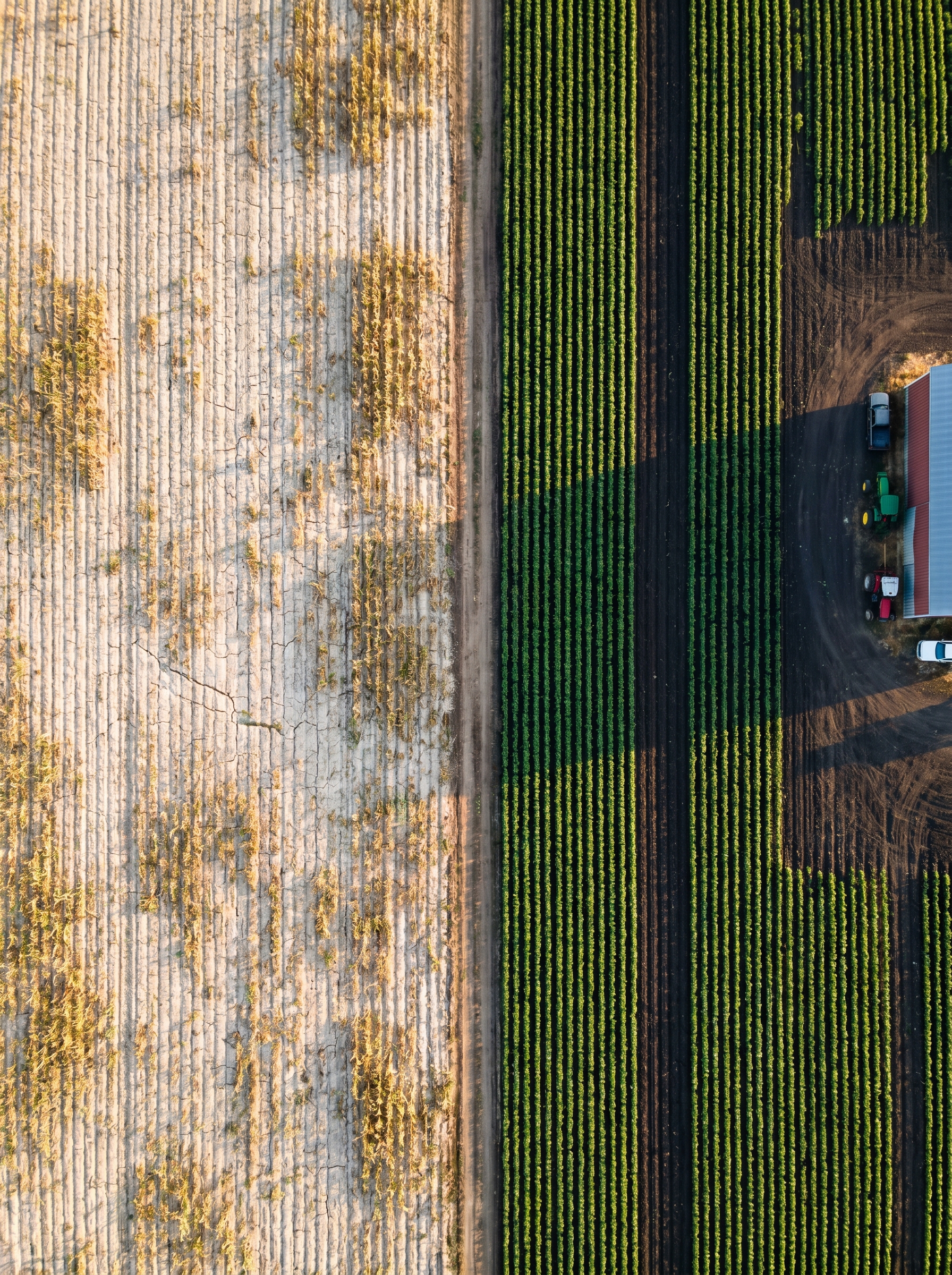
Same Field · Same Season · Left: No Biochar · Right: Biochar Applied · The Evidence Is In the Earth
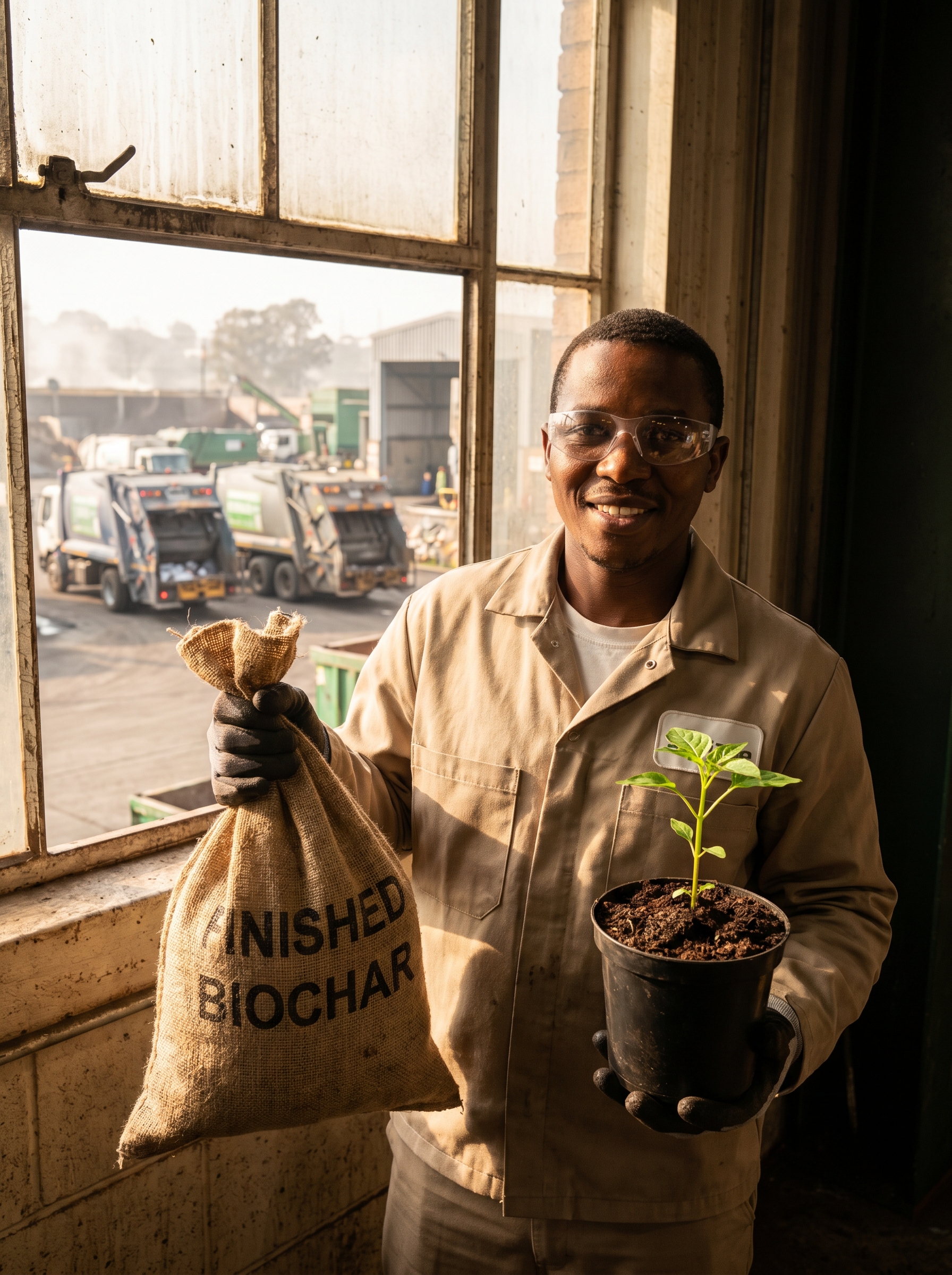
Biochar — the black carbon produced by pyrolysis of organic waste — has been used as a soil amendment for thousands of years. The terra preta soils of the Amazon, created by pre-Columbian civilisations using charred organic material, remain extraordinarily fertile 2,000 years after their creation. Modern peer-reviewed research confirms: biochar application increases crop yields by 10–40%, reduces water requirements by up to 20%, decreases fertiliser need by up to 30%, and sequesters carbon in soil for hundreds to thousands of years.
💰 The Revenue Model — Four Simultaneous Income Streams
Stream 1 — Gate fees: Municipalities pay $50–150/tonne to have waste collected and processed. You receive payment for your raw material. Stream 2 — Product sales: Biochar ($500/tonne), electricity (grid rate), fuel gas (industrial rate), building panels ($150/m²), clean water (municipal rate), recycled metal (market rate). Stream 3 — Carbon credits: Every tonne of carbon locked into biochar generates $100–200 in certified carbon credits under the voluntary carbon market. Stream 4 — Gate fee avoidance value: Regions with landfill bans or taxes pay premium rates for guaranteed zero-landfill processing. One facility processing 50,000 tonnes per year generates $8–15M in annual revenue from four simultaneous streams, with the raw material arriving at negative cost.
"There is no such thing as waste. There is only material in the wrong place. The business opportunity is moving it to the right place — and the right place for every material turns out to be extraordinarily valuable."
— Circular Economy First Principle · Ellen MacArthur Foundation · 2013
$8–15M
Annual Revenue Per Facility — From Material That Arrives at Negative Cost
A facility processing 50,000 tonnes of mixed municipal waste per year — a medium-sized city's annual output — generates $8–15M in combined revenue from gate fees, product sales, carbon credits, and avoided landfill costs. The capital cost of building such a facility is $15–25M. Payback period: 2–4 years. After payback, the facility generates this revenue indefinitely, with the raw material continuing to arrive for free — because cities will always produce waste.
Why Now
The Opportunity
Why Nobody Has Built This — And Why 2026 Is the Year
The individual technologies only recently became affordable simultaneously. Pyrolysis, gasification, and hydrothermal systems each had different commercialisation timelines. All three reached commercially viable cost levels between 2018 and 2023. The integration of all three into one system — which requires all three to be simultaneously economical — only became financially viable in the last three years. The window to build the first integrated system is open now.
Carbon credit markets reached viability in 2022–2024. The voluntary carbon market — which provides the third revenue stream — was too small and too uncertain to support investment decisions before 2022. It has since grown to $2B annually and is projected to reach $50B by 2030. Biochar carbon credits are among the most premium in the market — because biochar sequesters carbon for hundreds of years, producing a "permanent" credit that commands $100–200/tonne vs $5–15 for forestry credits.
Landfill bans are creating urgent demand. The EU has mandated progressive reductions in landfill use since 2018, with many member states targeting zero landfill by 2035. The UK, Australia, and several US states have similar targets. Every municipality facing a landfill ban needs an alternative processing solution urgently. The companies that build universal waste processing facilities in the next five years will be operating under long-term government contracts by 2030.
Food security pressure is creating premium biochar demand. With global food demand rising and soil degradation affecting 40% of agricultural land, biochar's yield-improvement properties are attracting serious agricultural investment. Premium biochar sells for $400–700 per tonne — and demand is growing faster than supply. A waste processing facility that produces biochar as a byproduct is simultaneously a premium agricultural input business.
The integration is the moat. Any single technology — a pyrolysis unit, a gasification plant — can be replicated by competitors. An integrated system with established waste supply contracts, operating data, multiple certified output streams, and a proven revenue model is extraordinarily difficult to replicate. The first company to build and operate a fully integrated universal waste conversion system at commercial scale will have a documented operating record that no new entrant can match for years.