You were told that education is the path to success. You were not told that the education system was designed — with specific, documented, historical intent — not to produce successful, independent, creative human beings, but to produce compliant, punctual, obedient workers for an industrial economy that no longer exists. The history of how your education was designed is one of the most important stories nobody ever taught you in school.
This is not a conspiracy. It is documented history, written in government records, educational philosophy papers, and the published intentions of the people who built the system you attended. The system worked exactly as designed. The question is whether what it was designed to produce is what you actually needed to become.
Chapter 01 · The Origin
Who Built the System — And Why
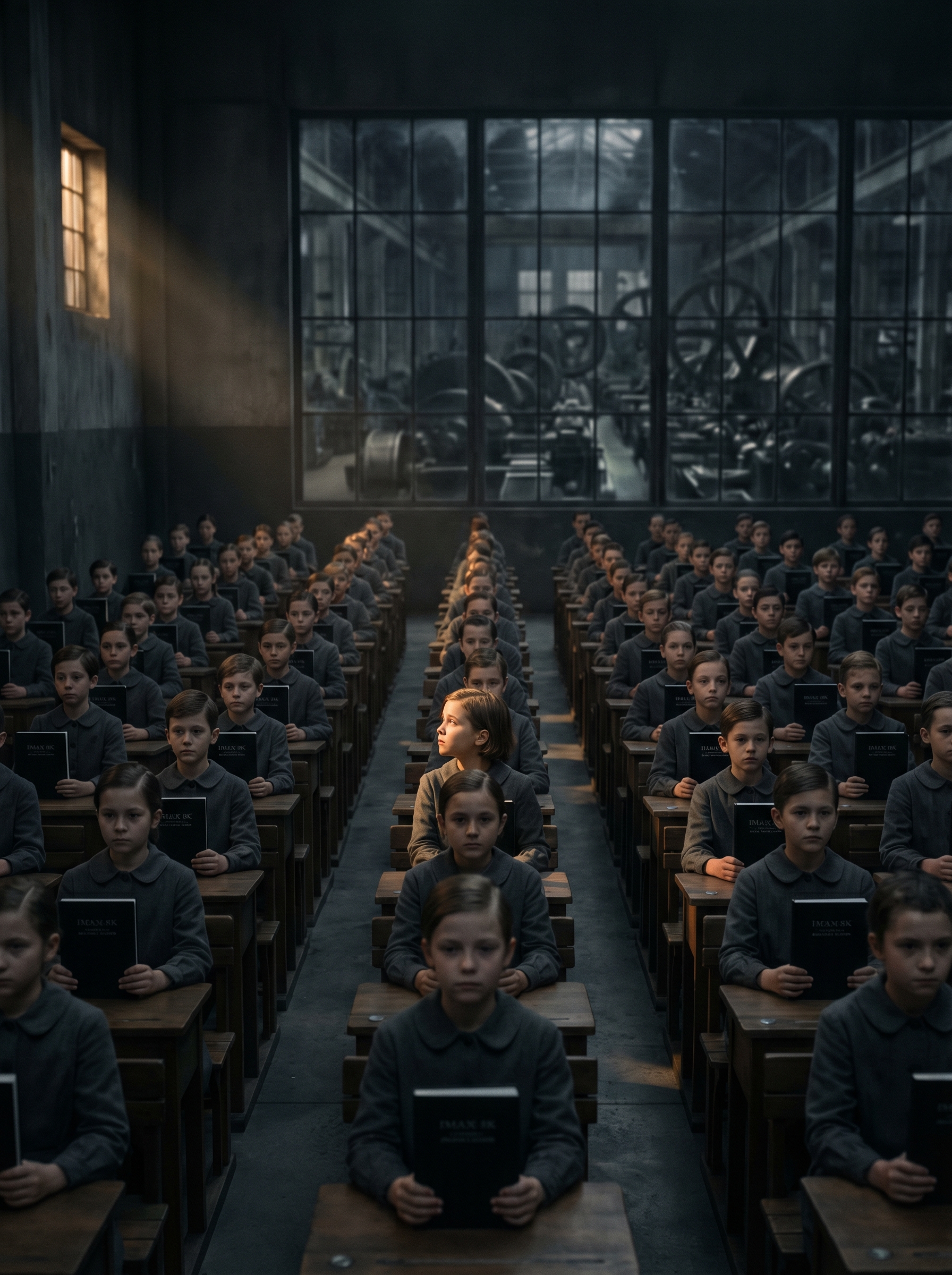
Identical Rows · Identical Uniforms · Identical Curriculum · Designed in 1806 · Still Running Today
In 1806, Napoleon defeated the Prussian army at the Battle of Jena. The defeat was so total — an empire collapsed in weeks — that the Prussian government convened an emergency commission to understand what had gone wrong. Their conclusion: the soldiers had shown independent thinking when they should have followed orders. The officers had made individual decisions when the system required obedience. The solution they designed was mass compulsory education.
The Prussian education model, formally introduced between 1807 and 1819, had explicit design goals articulated by its architects. Johann Gottlieb Fichte, one of the system's primary philosophical designers, wrote in his Addresses to the German Nation (1808): the goal was to produce citizens who would not need to be coerced into obedience — because they would have been trained from childhood to obey naturally. The system was built around fixed schedules, bells, compulsory attendance, standardised curriculum, external examination, and the systematic suppression of individual pace and interest. Every feature of the school you attended was designed with this purpose.
📜 The Historical Record
The Prussian model was adopted by the United States in the 1840s, championed by Horace Mann after his tour of Prussian schools. Mann explicitly praised the system's ability to produce "docile, obedient, efficient" students who would transition smoothly into factory and military life. The model spread to Britain, France, and across the colonial world. By 1900, virtually every country on Earth had adopted the Prussian structure — bells, grades, age-segregated classrooms, standardised testing, fixed curriculum — intact. The system you attended in 2024 has the same fundamental architecture as the military training programme designed in 1806.
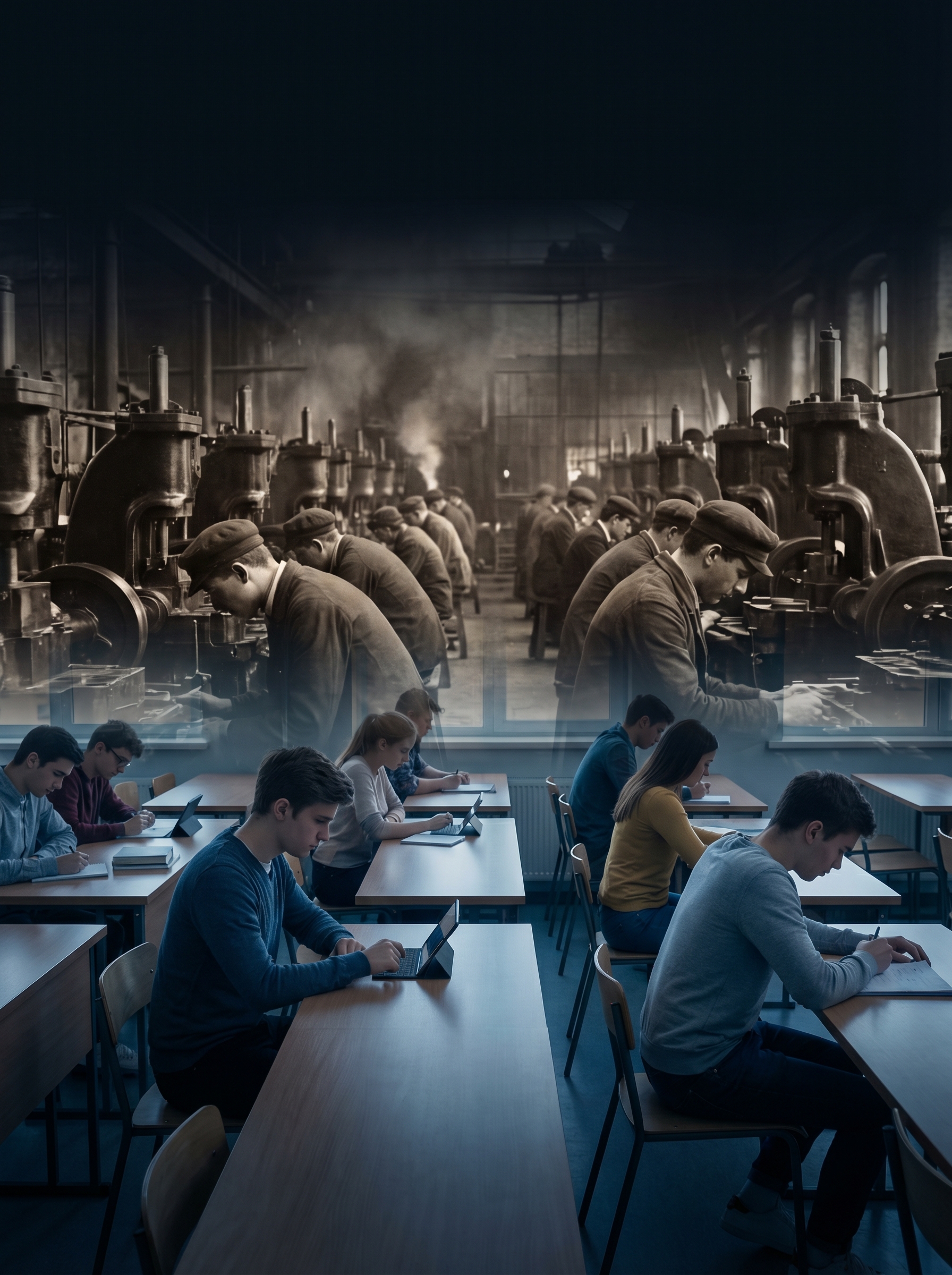
Factory 1806 · Classroom 2026 · Same Architecture · Same Bell · Same Rows · Same Purpose · Different Name
Chapter 02 · What It Does Not Teach
The Curriculum of Everything That Matters Was Left Out
The standard school curriculum is a remarkably consistent global document. Mathematics, language, literature, history, basic science, geography. Twelve to sixteen years of instruction. And at the end of it — for most students — the following subjects have received zero formal instruction: how money works, how compound interest operates, how to build a business, how to manage health, how to develop relationships, how to think critically about media and information, how to negotiate, how to fail productively, how to learn independently.
This is not an accident. A curriculum designed to produce factory workers and soldiers does not need to teach financial independence — that would undermine the goal. It does not need to teach critical thinking about authority — that would undermine the design. The absence of these subjects from the curriculum is as intentional as the presence of everything that replaced them.
💸
Never Taught
How Money Actually Works
Compound interest, inflation, asset ownership, tax, debt mechanics — the financial systems that will govern your entire adult life received zero hours of instruction in the standard curriculum. You were taught algebra. You were not taught how your mortgage works.
🧠
Never Taught
How to Think — Not What to Think
Logic, epistemology, media literacy, source evaluation, cognitive bias recognition — the meta-skills that determine the quality of every decision you will ever make received almost no curriculum time. You were taught facts. You were not taught how to evaluate them.
🏥
Never Taught
How Your Body and Mind Work
Sleep science, nutrition, exercise physiology, stress management, mental health maintenance — the operating manual for the only body and mind you will ever have received token coverage at best. You were taught about photosynthesis. You were not taught how to sleep properly.
🤝
Never Taught
How to Build Relationships and Lead
Communication, negotiation, conflict resolution, empathy, persuasion, team-building — the interpersonal skills that determine career trajectory and life quality more than any academic subject received no formal instruction whatsoever. You were graded in isolation. You were not taught how to work with others.
1,460
Hours Per Year — and Zero on Financial Literacy
The average student spends approximately 1,460 hours per year in school across a 12-year education. That is 17,520 total hours. Of those hours, the average student receives zero formal instruction in personal finance, zero in entrepreneurship, zero in investment, and zero in the practical mechanics of the adult financial life they are about to enter. The education system has had your full attention for over seventeen thousand hours. It chose what to do with that time.
"I am entirely serious when I say that school as currently practised is one of the most reliable producers of the opposite of what it claims to produce — curious, independent, capable human beings."
— Sir Ken Robinson · Do Schools Kill Creativity? · TED Talk · Most Watched in TED History
Chapter 03 · The Evidence
What the Data Says About Education and Success
The Certificate · Hanging Empty · The Achievement Behind It · Needed No Permission · No Grade · No Degree
The relationship between formal educational credentials and financial success is weaker than the education system would have you believe — and the relationship between specific skills, independent thinking, and financial success is stronger. This is not an argument against education. It is an argument about what kind of education actually matters.
📊 The Dropout Data
Of the ten wealthiest people in human history as measured by inflation-adjusted net worth, the majority either dropped out of formal education, had no university degree, or built their wealth in ways entirely unrelated to their educational credentials. Bill Gates dropped out of Harvard. Steve Jobs dropped out of Reed College. Mark Zuckerberg dropped out of Harvard. Michael Dell dropped out of University of Texas. This does not mean dropping out is the path to success. It means that the credential is not the asset — the thinking, the building, and the doing are the assets. The school that produced these people did not produce their success. Their willingness to learn differently did.
The most comprehensive long-term studies of career success — including decades of research by Google on what makes their best employees excellent — consistently find that the qualities most predictive of professional performance are: intellectual curiosity, the ability to learn from failure, collaborative problem-solving, and the capacity to think through ambiguous problems. These are the exact qualities that the Prussian educational model was designed to suppress. The system that grades you for the right answer in a fixed time on a predetermined question is training you for the opposite of what success in the actual world requires.
What Actually Works
Chapter 04 · Real Learning
What Education Should Have Taught You
Self-Directed · Curious · Building Real Things · No Bell · No Grade · No Permission · This Is Learning
How to learn, not what to learn. The most valuable skill in a world where information is infinite and freely available is the ability to identify what you need to know, find it, evaluate its quality, and integrate it into your understanding rapidly. This meta-skill — learning how to learn — was not on your curriculum. It is the foundation of every competence you will ever build. The person who can teach themselves anything is more valuable in every economy than the person who was taught specific things.
How to fail and continue. The school system grades failure as a negative outcome to be avoided — a red mark, a failed year, a damaged transcript. In the actual economy, failure is the primary mechanism of learning — the method by which every business, every technology, and every human skill was developed. Every person who has built anything significant has failed repeatedly and visibly. Teaching you to avoid failure taught you to avoid the most reliable path to competence.
How compound learning works. Learning, like money, compounds. Skills built on skills. Knowledge applied to knowledge. The person who learns consistently across years in connected domains becomes exponentially more capable than the person who stops learning at graduation. The education system taught you that learning ends when school ends. The most successful people treat learning as a permanent, daily practice — not a phase that ends with a certificate.
How to build systems, not just complete tasks. Employment trains you to complete assigned tasks within defined parameters. Wealth and independence are built by people who create systems — structures that produce value without requiring constant individual input. The difference between an employee and an owner is largely this: one completes tasks, one builds systems. School trains you to be extraordinarily good at completing tasks. It teaches you almost nothing about building systems.
How to think for yourself about authority and information. Perhaps the most consequential absence from the standard curriculum is critical thinking about the sources, incentives, and reliability of information — including the information provided by the system you are inside. The Prussian model explicitly intended to produce citizens who trusted authority. The ability to evaluate claims, question assumptions, identify bias, and reach independent conclusions is the most important intellectual skill in an information-saturated world. It was never on the test.