The universe had a beginning. This is not a religious claim — it is the conclusion of modern cosmology, confirmed by the cosmic microwave background radiation, by the expansion of space, by general relativity, and by the Second Law of Thermodynamics. The universe began approximately 13.8 billion years ago. And that simple, scientifically established fact produces the most devastating question in the history of human thought: what was happening before it began?
Ask a physicist. Ask a philosopher. Ask a theologian. Ask the most sophisticated AI systems ever built. Every answer you receive will be, on careful examination, not an answer at all — but a restatement of the question in different language, or an attempt to dissolve the question by redefining its terms, or an admission dressed in enough technical vocabulary that the admission is not immediately visible. No one knows what was before the universe. More precisely and more disturbingly: the concept of "before" may not apply to the question at all — which is itself a statement that the question cannot be answered using any framework human thought has ever produced.
The Question
Why This Question Breaks Everything
t = 0 · The Point Before Which There Is No Point · The Beginning of Everything · Including Time Itself
The question "what was before the universe?" seems simple. It is, in fact, structured in a way that makes it logically impossible to answer using any framework that exists within the universe — because every framework for answering questions was created after the universe began, and operates using the rules that came into existence with it.
If the universe had a beginning — something must have caused it.
But that cause existed before causation did.
Which is logically impossible.
But it happened.
This is not a paradox that science will eventually resolve. · This is the limit. · Every framework ends here.
The problem is not simply that we do not have enough data. It is that the question contains a structural impossibility. Time itself began with the universe. This is not philosophical speculation — it is the mathematical conclusion of general relativity. If time began at the Big Bang, then there is no "before" the Big Bang in the same sense that there is no location north of the North Pole. The question is not unanswered. It may be unaskable. And yet — the universe exists. Something produced it. The unanswerable question points to something that is undeniably real.
Chapter 01 · The Theories
Every Answer Humanity Has Ever Tried — And Why Each One Fails
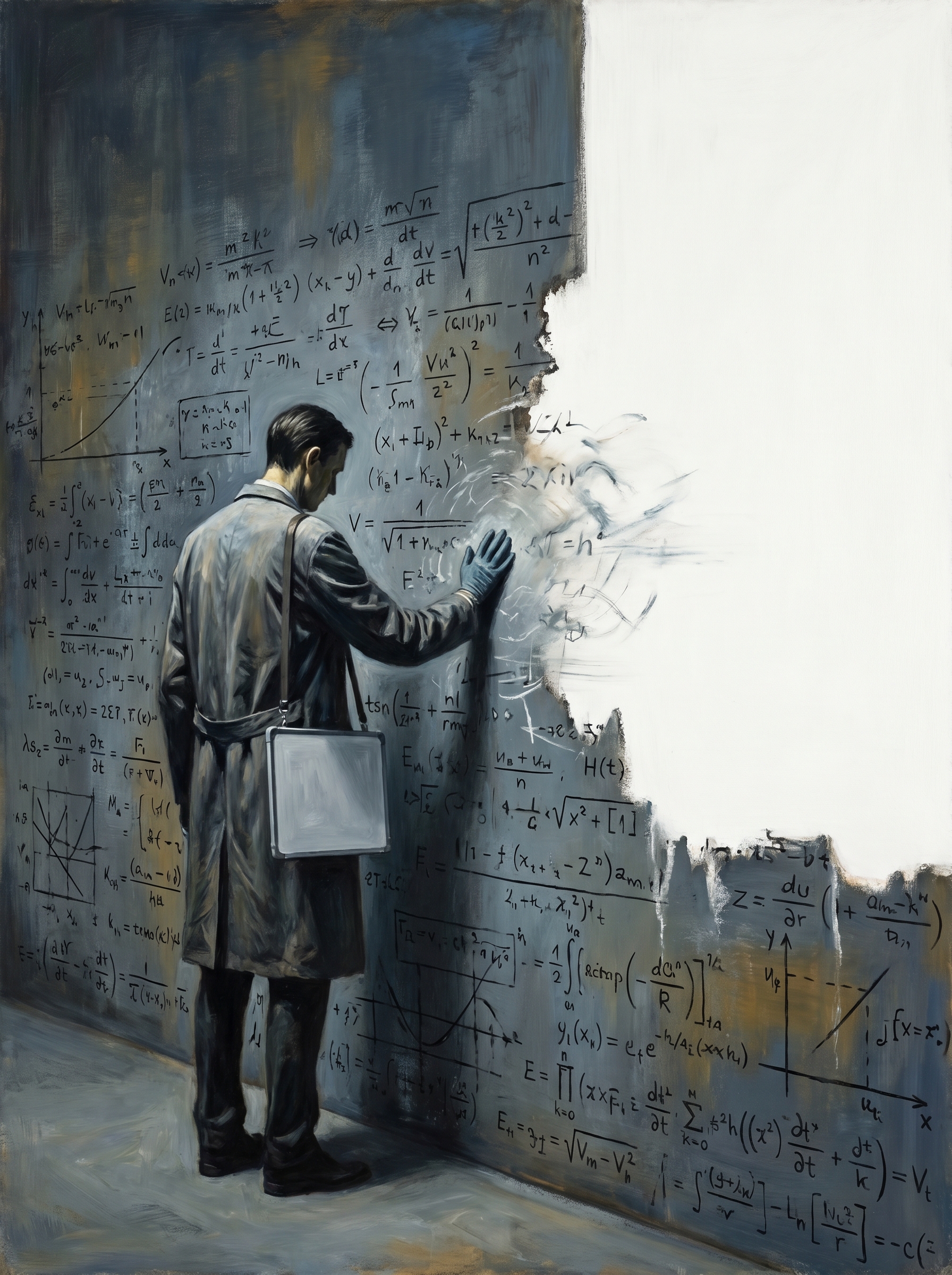
Every Theory · Written in Full · Crossed Out · At the Same Point · t = 0 · Beyond Which · Every Board Is Empty
💥
Fails at t=0
The Big Bang — Describes the Beginning. Not What Caused It.
The Big Bang theory is the most confirmed theory in cosmology. It describes everything that happened from the first fraction of a second onward with extraordinary precision. It says nothing about what caused the Big Bang. Asking a physicist what caused the Big Bang is like asking what is north of the North Pole. The theory ends exactly where the question begins.
🔁
Fails — Infinite Regression
Eternal Inflation — Pushes the Question Back Forever
The eternal inflation model proposes that our universe is one bubble in an infinite multiverse of inflating space — our Big Bang was a local event in a larger eternal process. But what caused the eternal inflation to begin? Every answer of this type simply pushes the original question one step further back. The question does not disappear. It retreats. Infinite regression is not an answer. It is the question wearing a different coat.
🧵
Fails — Untestable
String Theory and M-Theory — Cannot Be Tested
String theory and its extension M-theory propose extra dimensions and a landscape of possible universes that could explain why our universe's constants are what they are. They produce no testable predictions about what preceded the Big Bang. A theory that cannot be falsified is not a scientific theory — it is mathematics with aspirations. Beautiful mathematics. But not an answer to the question.
🔄
Fails at Singularity
Loop Quantum Gravity — The Bounce That Still Needs an Origin
Loop Quantum Gravity proposes that our universe "bounced" from a previous contracting universe — avoiding the singularity of the Big Bang. But the contracting universe that preceded the bounce had to come from somewhere. Even if the universe oscillates through infinite cycles of expansion and contraction, the series of cycles itself requires an origin — or it must be truly infinite in the past, which produces its own profound problems.
Chapter 02 · Hawking's Answer
The Most Honest Answer Ever Given — And Why It Is Still Not An Answer
The Wall · Equations End Here · The Hand Touching It · The Dissolution · The Limit · Inside the Limit
Stephen Hawking, in his No-Boundary Proposal developed with James Hartle, offered what is perhaps the most sophisticated attempt at dissolving the question. Using imaginary time — a mathematical technique that treats time as a spatial dimension — the model describes the universe as having no boundary, no edge, no singular beginning. In imaginary time, the universe has no beginning in the same way a sphere has no edge. There is no "first moment" from which everything else follows.
🔬 Hawking's Own Words — The Most Honest Statement in Physics
"Since events before the Big Bang have no observational consequences, one may as well cut them out of the theory and say that time began at the Big Bang. Events before the Big Bang are simply not defined, because there is no way of measuring what happened at them." — Stephen Hawking, A Brief History of Time. This is not an explanation of what was before the universe. It is a precise statement that the question cannot be answered — not because we lack information, but because the concept of "before" does not apply. The most brilliant mind of his generation's best answer was: the question does not have the shape we think it has. This is profound. It is honest. And it is not an answer.
"What is north of the North Pole? The question seems to have a form. It does not have an answer. The question of what came before the Big Bang may have exactly this structure."
— Stephen Hawking · A Brief History of Time · The Most Purchased Science Book in History
Chapter 03 · The Deeper Problem
Why Even Dissolving the Question Does Not Dissolve It
Before the First Second · There Was No Second · The Clock Unmakes Itself · Toward a Point That Cannot Be Pointed At
Hawking's approach — treating the question as malformed rather than unanswerable — is philosophically sophisticated. But it does not eliminate the underlying problem. Even if time has no beginning in the mathematical model, the physical universe — the matter, energy, space, and the laws of physics themselves — still requires an explanation for its existence.
Why do the laws of physics have the form they have? Why do electrons have the mass they have? Why is the speed of light what it is? Why does the universe permit the existence of atoms, chemistry, planets, life? Every one of these values is extraordinarily precisely calibrated — change any of them by a fraction and matter cannot form, stars cannot burn, life cannot exist. The No-Boundary Proposal does not explain why any of this is so. It relocates the question without answering it. The existence of something rather than nothing remains the deepest question in all of human thought — and it has never been answered.
10⁻⁴³s
The Planck Time — The Closest Physics Gets to the Beginning
The Planck time — approximately 5.39 × 10⁻⁴⁴ seconds — is the smallest meaningful unit of time in physics. Before this point, the known laws of physics break down completely. General relativity and quantum mechanics produce contradictory infinities when applied to conditions before Planck time. Every theory of physics fails simultaneously at this boundary. The universe's first 10⁻⁴³ of a second is not just unknown — it is unknowable using any physics that currently exists.
What Remains
Chapter 04 · The Honest Conclusion
What It Means That This Question Has No Answer
Every answer is a restatement of the question. "God created the universe" — but who created God? "The universe emerged from a quantum vacuum" — but why did the quantum vacuum exist, and why did it have the properties it had? "The universe is eternal" — but an eternally old universe violates the Second Law of Thermodynamics, which requires a beginning. Every answer to "why is there something rather than nothing?" contains the question again, one level deeper. This is not ignorance. This is the structure of the question itself.
The laws of physics were created with the universe — so they cannot explain it. Every physical law that exists came into being at the Big Bang or in the moments immediately following. Using physics to explain the origin of physics is like using a ruler to measure itself. The tool and the thing being measured are the same thing. Any explanation of the universe's origin that uses physical laws is circular — it assumes the very thing it is trying to explain.
Mathematics may be the only thing that transcends the question — and even that is uncertain. Some physicists, including Max Tegmark of MIT, argue that mathematical structures exist independently of physical reality — that the universe is, at its deepest level, a mathematical object, and mathematics is prior to physics. This would mean that what existed "before" the universe was pure mathematical structure — eternal, necessary, uncaused. This is the most serious scientific attempt to answer the question. It is also entirely unverifiable and rests on metaphysical assumptions as large as any theology.
The question reveals the limit of human cognition — not just human knowledge. The human mind evolved to navigate a world of middle-sized objects moving at moderate speeds in three spatial dimensions and one time dimension. The question of what preceded time asks that mind to operate outside every condition that shaped it. We may simply not have the cognitive hardware to hold this question properly. A dog cannot understand calculus — not because the dog is unintelligent, but because the dog's mind was not built for that class of problem. The human mind's relationship to the question of the universe's origin may be exactly analogous.
The question is the most important one ever asked — and always will be. The fact that it has no answer is not a reason to stop asking it. Every advance in cosmology, in quantum gravity, in the philosophy of time and causation, has been driven by the pressure of this question. The limit of knowledge is where knowledge grows. The question that cannot be answered is the most productive question in existence — because it forces every framework to its boundary, and at boundaries is where the new territory begins.