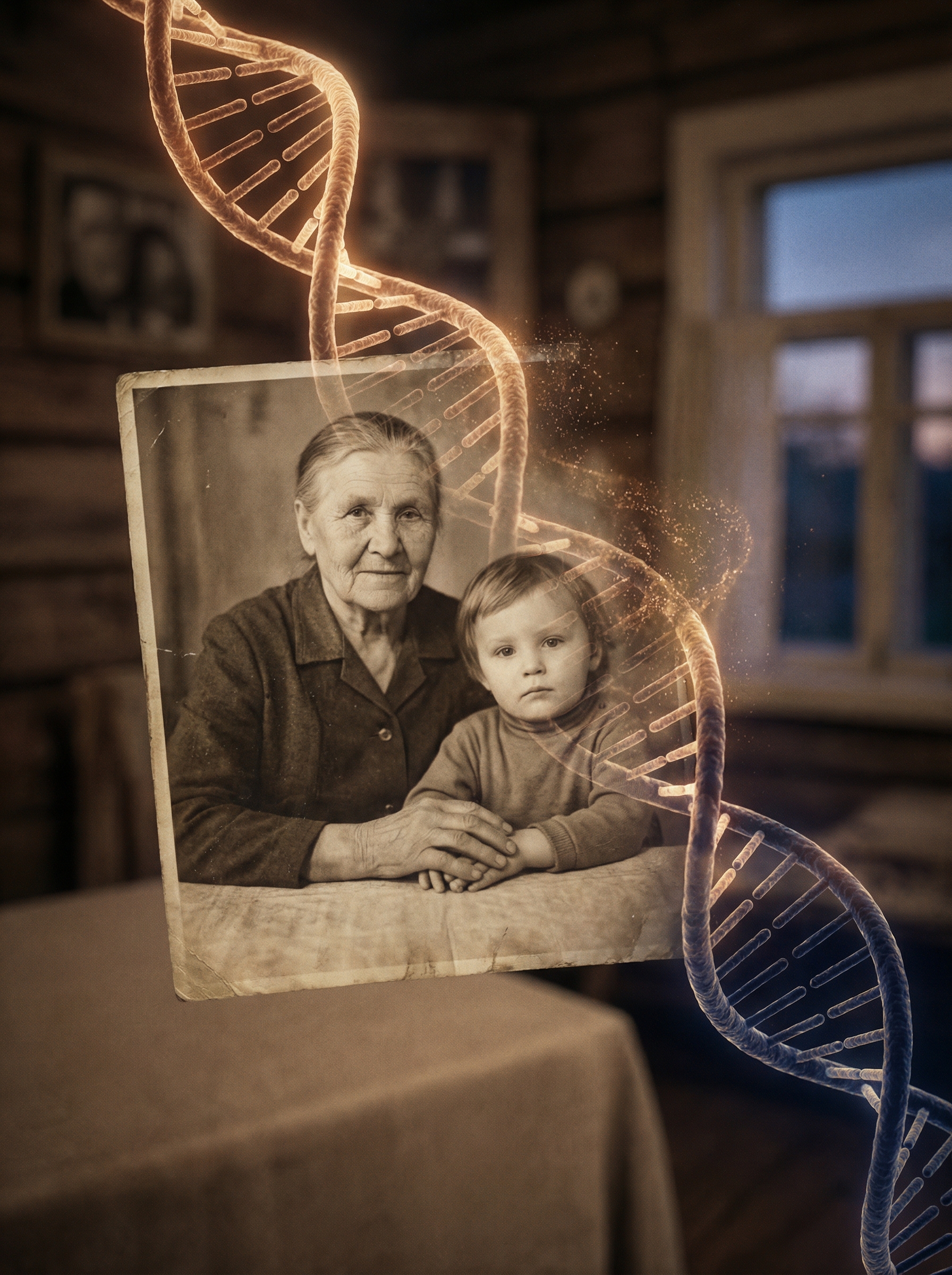
The anxiety you feel in the dark. The inexplicable sadness that sometimes arrives without reason. The fears that make no sense given your own life experience. Science now has an answer for all of it — and that answer will change the way you understand yourself, your family, and what it means to be human. Your ancestors' pain did not end with them. It is alive inside you, written in the language of your DNA.
For most of human history, we believed that what happened to your grandparents stayed with your grandparents. Their experiences — their joy, their suffering, their terror, their grief — belonged to them and ended when they died. Your DNA, we thought, was a fixed blueprint: an instruction manual you inherited but that was not written by the lives they lived. That belief was wrong. And the science that proved it wrong is one of the most extraordinary discoveries in the history of human biology.
I
The Discovery
What Is Epigenetics — And Why It Changes Everything
Your DNA is the fixed sequence — the letters of the genetic code that determine the colour of your eyes, the shape of your nose, your blood type. That does not change. But sitting on top of your DNA is a second layer of biological information called the epigenome — a system of chemical tags and markers that controls which of your genes are switched on and which are switched off, and how powerfully each gene is expressed.
This epigenome is not fixed. It changes in response to your environment — to stress, to diet, to trauma, to love, to deprivation. And here is where the story becomes extraordinary: these epigenetic changes can be passed from parent to child, and from grandparent to grandchild, across generations. The experiences your ancestors lived through — the famines, the wars, the grief, the terror — left marks on their epigenome. And those marks were inherited by their children. And their children's children. And you.
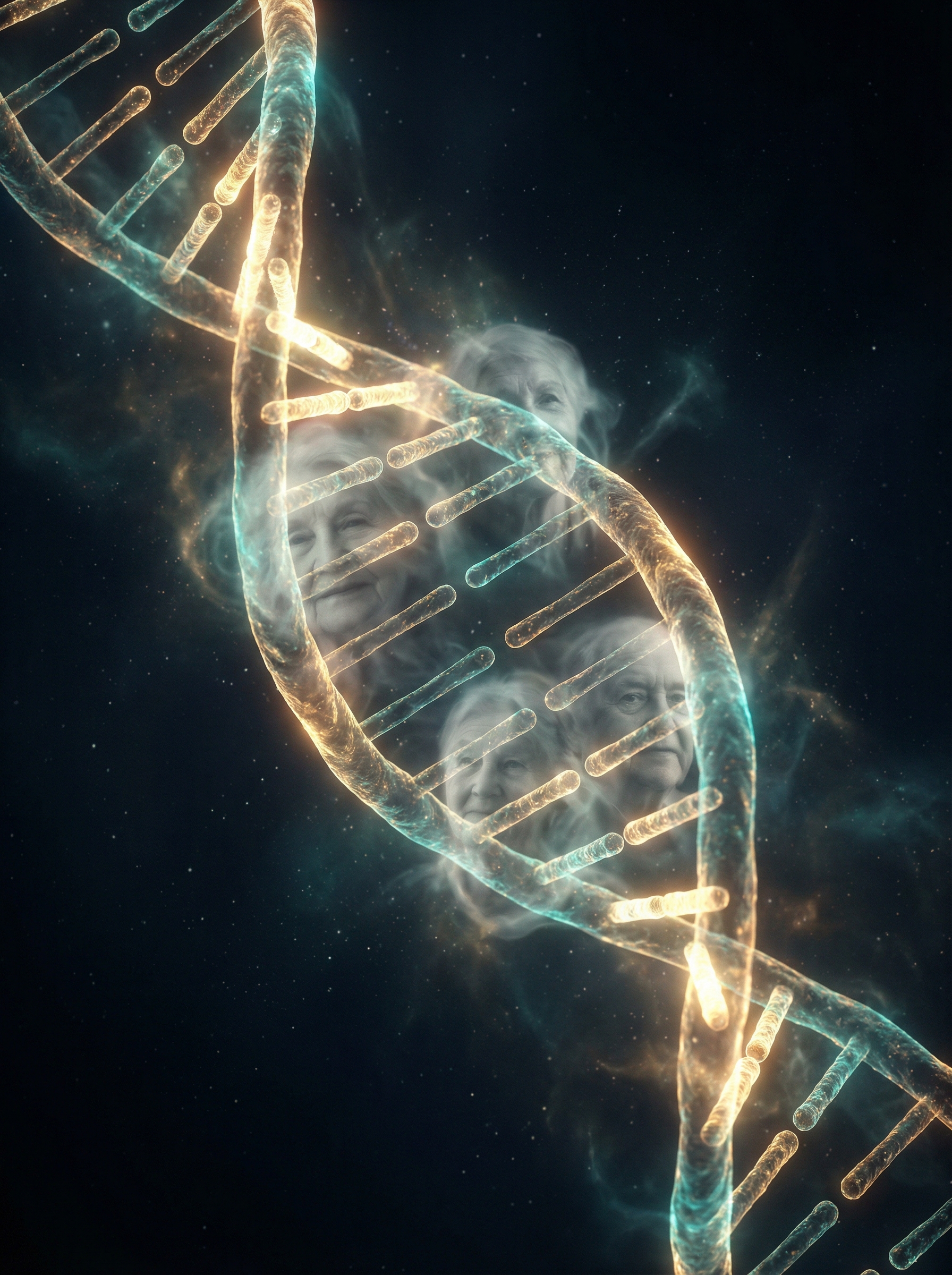
The Epigenome · Chemical Markers on Your DNA · Written by Your Ancestors' Lives
🔬
The Science
DNA vs Epigenome
Your DNA sequence is fixed at conception. Your epigenome — the layer of chemical markers controlling gene expression — changes throughout life and can be inherited. This is the distinction that changes everything.
⚗️
The Mechanism
How Trauma Marks Genes
Severe stress triggers the addition or removal of methyl groups on DNA — chemical tags that silence or amplify specific genes. These methylation patterns are reproduced when cells divide — including the cells that become eggs and sperm.
👶
The Inheritance
How It Reaches You
Your grandmother's epigenetic marks were present in the egg that became your parent. Your parent's epigenome — already shaped by inherited marks — further changed in response to their own experiences, and was then passed to you.
II
The Proof
The Studies That Proved It Was Real
Epigenetic inheritance was a controversial theory until researchers stopped theorising and started measuring. What they found, in controlled studies using some of the most well-documented populations of trauma survivors in history, was not ambiguous. The biological marks of extreme suffering were present — measurably, statistically significantly — in the children and grandchildren of people who had never personally experienced that suffering.
🔬 Study 01 — The Holocaust Survivor Research
Rachel Yehuda and her team at Mount Sinai School of Medicine studied Holocaust survivors and their adult children. They found that both groups showed identical, abnormal patterns of cortisol regulation — the stress hormone — compared to Jewish families who were not in Europe during the war. The children had never experienced the Holocaust. But their stress response systems were biologically identical to people who had. The trauma had been chemically inherited.
🔬 Study 02 — The Dutch Hunger Winter
In the winter of 1944–45, Nazi forces blockaded food supplies to the western Netherlands. 20,000 people starved to death. The children born to women pregnant during this famine were smaller than average — expected. But their grandchildren were also smaller than average — despite adequate nutrition their entire lives. The epigenetic marks of starvation had survived two generations of normal feeding. The hunger was remembered in DNA for sixty years.
🔬 Study 03 — The Mouse Experiments
In controlled laboratory conditions, researchers at Emory University trained male mice to fear a specific cherry blossom scent by pairing it with mild electric shock. The mice's pups — who had never smelled cherry blossom and never experienced any shock — showed heightened anxiety responses specifically to that scent. Their grandpups showed the same response. The fear of a specific smell had been transmitted across three generations through epigenetic inheritance alone.
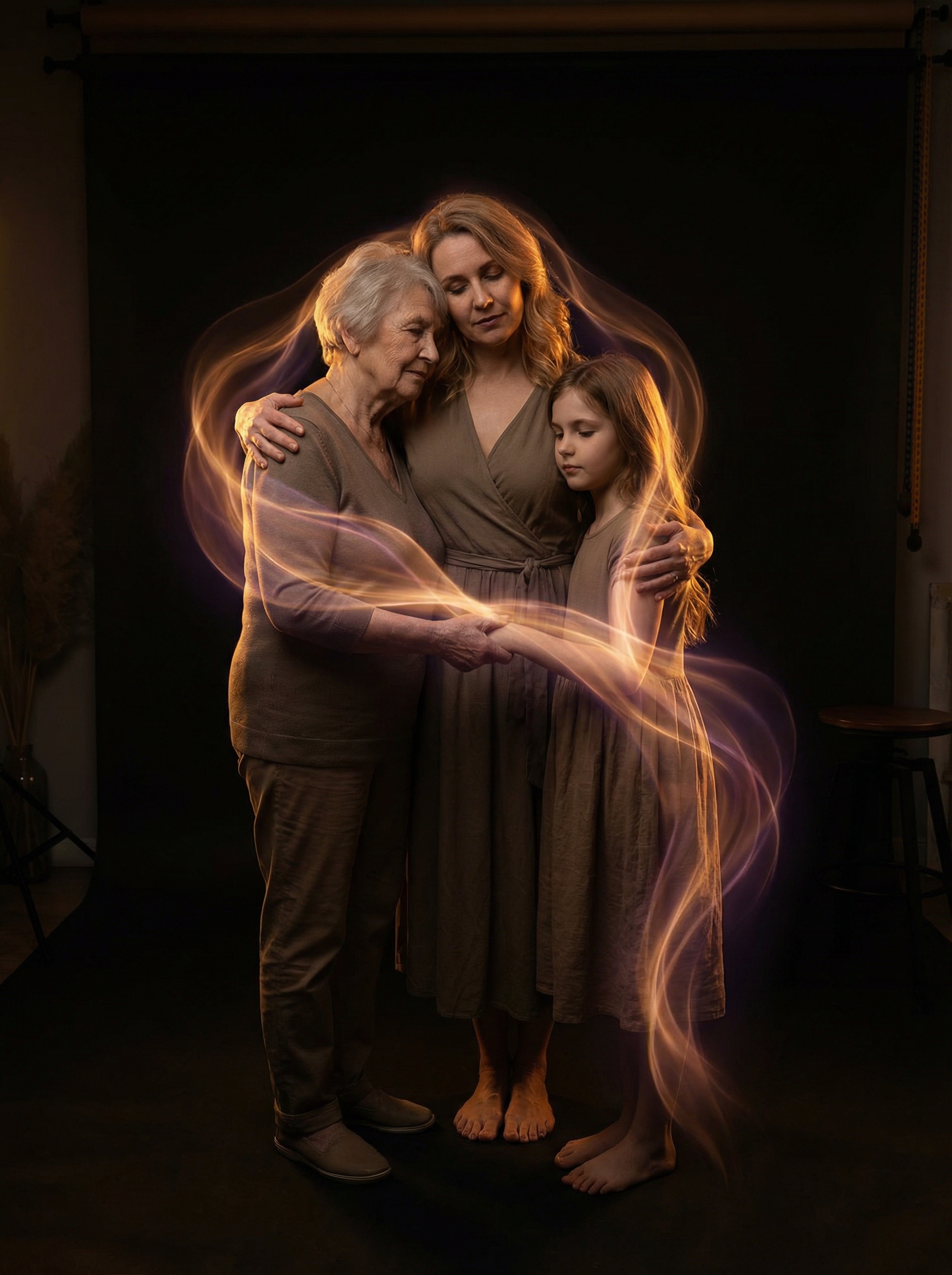
Three Generations · The Same Story · Written in Different Bodies
3
Generations — How Far Epigenetic Marks Have Been Measured
Current research has documented epigenetic transmission across at least three generations in both human and animal studies. What happened to your great-grandmother — her starvation, her terror, her grief, her joy — left marks that were present in the eggs inside your grandmother before your parent was even conceived. You are the third generation. The marks are in you right now.
III
What It Means For You
Which Parts of You Are Actually Yours?
This is the question that sits at the heart of everything. If your anxiety response was shaped by your grandmother's experience of war, is that anxiety yours? If your relationship with food was epigenetically influenced by a great-grandparent who starved, is your eating behaviour truly your own? If your capacity for trust was biologically shaped by generations of betrayal or hardship that you never personally experienced — where do your ancestors end and you begin?
The science does not suggest that you are merely a vessel for inherited trauma — a passive receiver of damage you had no part in creating. It suggests something far more nuanced and, ultimately, more hopeful. The epigenome is not permanent. The same plasticity that allowed trauma to be written into it can allow healing to be written into it. The marks your ancestors left can be changed by your own experiences — by therapy, by safety, by love, by the deliberate cultivation of conditions that tell your epigenome a different story than the one it inherited.
Your stress response may be inherited. Heightened cortisol reactivity — the biological pattern that makes some people more prone to anxiety and stress disorders — has been documented in the children and grandchildren of trauma survivors. If you find yourself reacting to stress more intensely than circumstances seem to warrant, it may not be a personal weakness. It may be an epigenetic inheritance from someone who needed that sensitivity to survive.
Your relationship with food may carry history. Epigenetic marks from famine and food insecurity have been shown to alter metabolism, appetite regulation, and the psychological relationship with eating across generations. Disordered eating patterns in families may carry biological as well as psychological inheritance — the body's memory of scarcity outlasting the scarcity itself by decades.
Your capacity for trust may have been shaped before you were born. Communities that experienced sustained persecution, displacement, or betrayal show measurable differences in epigenetic markers associated with social bonding and trust response. The difficulty some people have in trusting others may carry biological ancestry that goes back further than any personal experience.
But joy and resilience are also inherited. The epigenome does not only carry suffering. Positive experiences — deep safety, consistent love, community belonging, experiences of triumph and restoration — also leave epigenetic marks. Your ancestors' greatest moments of joy and survival may be as present in your biology as their suffering. The research is only beginning to map this positive inheritance.
Your healing heals your children. Perhaps the most profound implication of epigenetic inheritance is forward-looking. The therapeutic work you do — the trauma you process, the safety you build, the healing you achieve in your own lifetime — does not only benefit you. It changes your epigenome. And those changes will be part of what you pass to your children. Every person who heals themselves is, in the most literal biological sense, healing the future.

The Epigenome · Chemical Tags on DNA · Changed by Experience · Inherited Across Generations
IV
The Bigger Picture
History Is Alive in Human Biology
Zoom out from the individual and the implications become staggering. Every major historical trauma — every genocide, every famine, every sustained period of persecution or displacement — left epigenetic marks in the descendants of those who lived through it. Those descendants are alive today. Their biology carries the molecular memory of events that happened decades or centuries before their birth.
The descendants of enslaved people carry epigenetic marks from the specific biological stress profile of chattel slavery. The grandchildren of famine survivors in Ireland, in Bengal, in Ukraine, in China carry metabolic epigenetic patterns shaped by starvation they never experienced. The children of war refugees carry stress response profiles calibrated for dangers that belong to a world their parents fled. History is not over. It is alive in human biology, running quietly in the background of billions of lives.
"We are not just the products of our own experiences. We are the biological summary of everything our ancestors survived."
— Dr. Rachel Yehuda · Professor of Psychiatry · Mount Sinai School of Medicine · Pioneer of Epigenetic Trauma Research
This science does not excuse the past or explain away the present. It does something more important: it provides a biological framework for understanding why the effects of historical trauma persist long after the conditions that created it have ended. And it suggests, with extraordinary implications for medicine, psychology, and public health, that healing generational trauma is not merely a metaphor. It is a measurable biological process, with measurable biological outcomes, that can be documented in the DNA of the generations that follow.