Everything you have been told about how AI learns is half the story. The popular version says: humans collect data, humans label it, AI learns from labels. That is supervised learning — and it describes roughly 2% of how modern AI actually works. The other 98% is something far stranger, far more powerful, and almost never explained to the public. AI is teaching itself. And it is getting better at teaching itself than humans ever were.
The largest AI models in existence — GPT-4, Gemini Ultra, Claude 3 Opus, Llama 3 — were not primarily trained on human-labelled datasets. They were trained on raw, unlabelled text, images, and code, using algorithms that generate their own training signal from the data itself. No human sat and labelled billions of sentences. The AI looked at the data and invented the question it would use to learn from it. This is called self-supervised learning, and it is the most important idea in the history of artificial intelligence.
CHAPTER 01
The Problem With Teaching Machines the Old Way
To understand why self-supervised learning is revolutionary, you need to understand the problem it solved. For most of AI's history, training a machine learning model required labelled data — examples where a human has explicitly marked what each piece of data means. A photo labelled "cat." A sentence labelled "positive sentiment." A medical scan labelled "tumour present."
This approach works. But it has an enormous, often fatal limitation: labelling data is extraordinarily expensive, slow, and finite. Hiring humans to label millions of images costs millions of dollars. Training a model that can understand language at a human level would require labelling trillions of sentences — an amount of human labour that is practically impossible. The old approach hit a ceiling. The AI could only be as intelligent as the volume of human labelling effort it received.
Old Method — Supervised Learning
training_data = [
{ input: "The movie was amazing", label: "positive" },
{ input: "I hated every minute", label: "negative" },
]
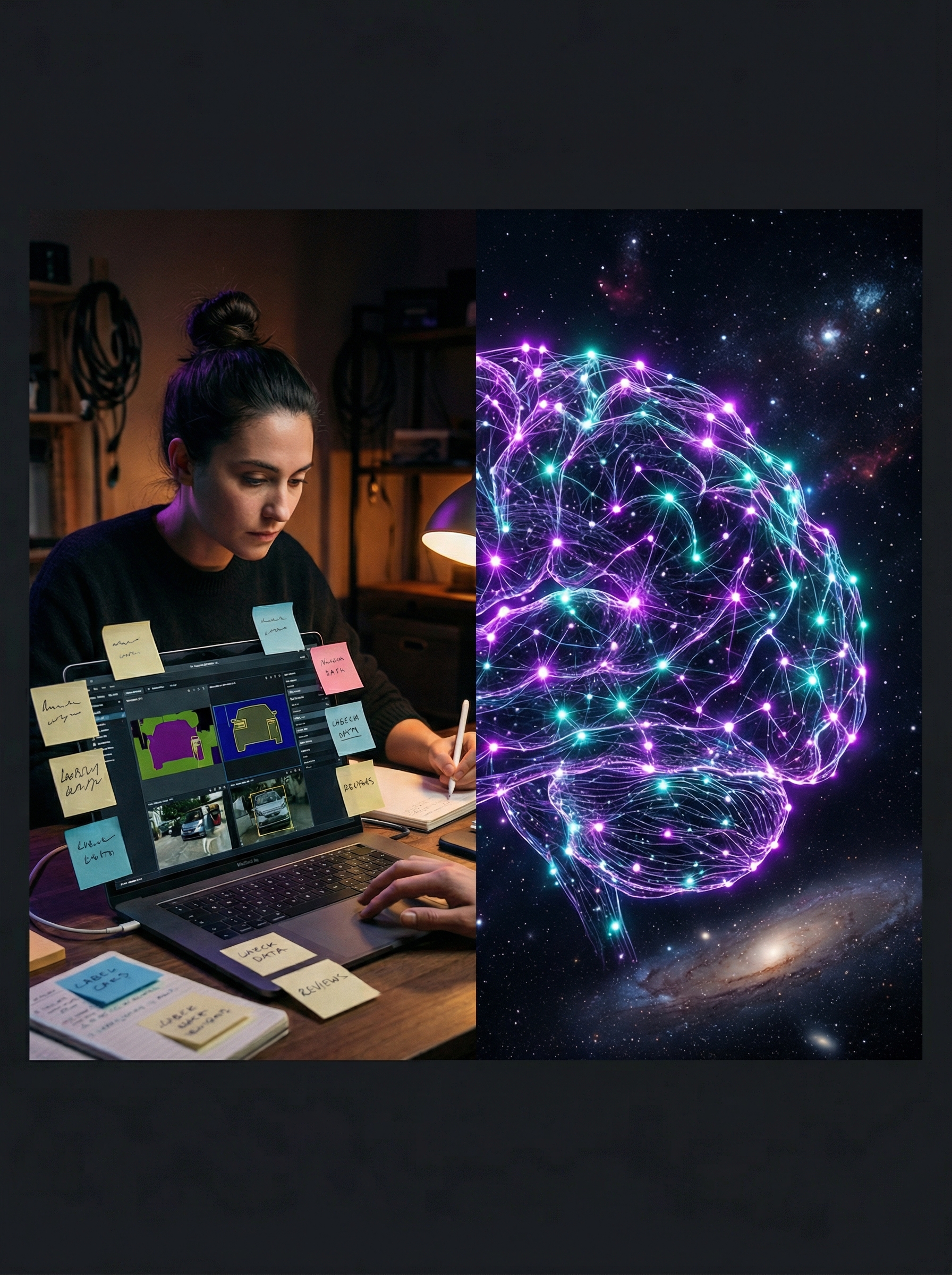
Supervised vs Self-Supervised · The Gap That Changed Everything
CHAPTER 02
The Breakthrough — AI That Creates Its Own Teacher
The key insight behind self-supervised learning is deceptively simple: you can hide part of the data and train the AI to predict what is missing. You do not need a human label. The missing piece IS the label. The data labels itself.
Consider a sentence: "The astronaut floated through the _____ of the space station." A human reading that sentence does not need to be told what word goes in the blank. They know, from all the context, that the word is probably corridor or airlock or module. An AI trained to predict masked words in millions of sentences learns, through nothing but this prediction task, to understand grammar, facts about the world, logical relationships, and something remarkably close to meaning — all without a single human label.
Self-Supervised — AI Creates Its Own Labels
original_sentence = "The cat sat on the warm mat"
masked_input = "The cat sat on the [MASK] mat"
auto_label = "warm"
supervised_data = ~10 million
selfsupervised = ~15 trillion
intelligence_gain = EXPONENTIAL
This is how BERT, GPT, and every large language model learns language. The training objective — predict the masked or next word — seems almost trivially simple. But to predict words accurately across trillions of examples in thousands of contexts, the model must develop a deep internal representation of the world itself. It learns what astronauts are, what space stations look like, what actions are physically possible, and what words mean — because all of that knowledge is implicit in the prediction task.
CHAPTER 03
The 6 Ways AI Teaches Itself Right Now
Self-supervised learning is not one technique — it is a family of methods, each exploiting a different structural property of data to generate training signal without human labels. Here are the six most powerful approaches active in the latest AI systems.
🎭
Language
Masked Language Modelling
Randomly hide 15% of words in a sentence. Train AI to predict them. Used by BERT, RoBERTa. Forces AI to learn grammar, facts, and context simultaneously — from raw text alone.
➡️
Prediction
Next Token Prediction
Show AI words 1 to N. Train it to predict word N+1. The method behind every GPT model ever built. Trained on the entire internet, it produces emergent reasoning, maths, and creativity.
🔀
Vision
Contrastive Learning
Show AI two views of the same image. Train it to recognise them as the same object. Used in CLIP and DALL·E. AI learns visual concepts without any image labels — just by comparing.
🖼️
Images
Masked Autoencoding
Hide 75% of an image. Train AI to reconstruct the missing pixels. Used in MAE (Meta). Forces AI to understand objects, textures, lighting and spatial relationships from raw images alone.
🤖
AI × AI
RLAIF — AI Trains AI
One AI generates responses. A second AI judges which is better. First AI trains on the judgment. No humans in the loop at all. Used in Claude, Gemini. AI improves itself indefinitely.
🧪
Synthetic
Synthetic Data Generation
AI generates millions of fake but realistic training examples — maths problems, code snippets, conversations — then trains on them. AI creates better data than humans can collect.
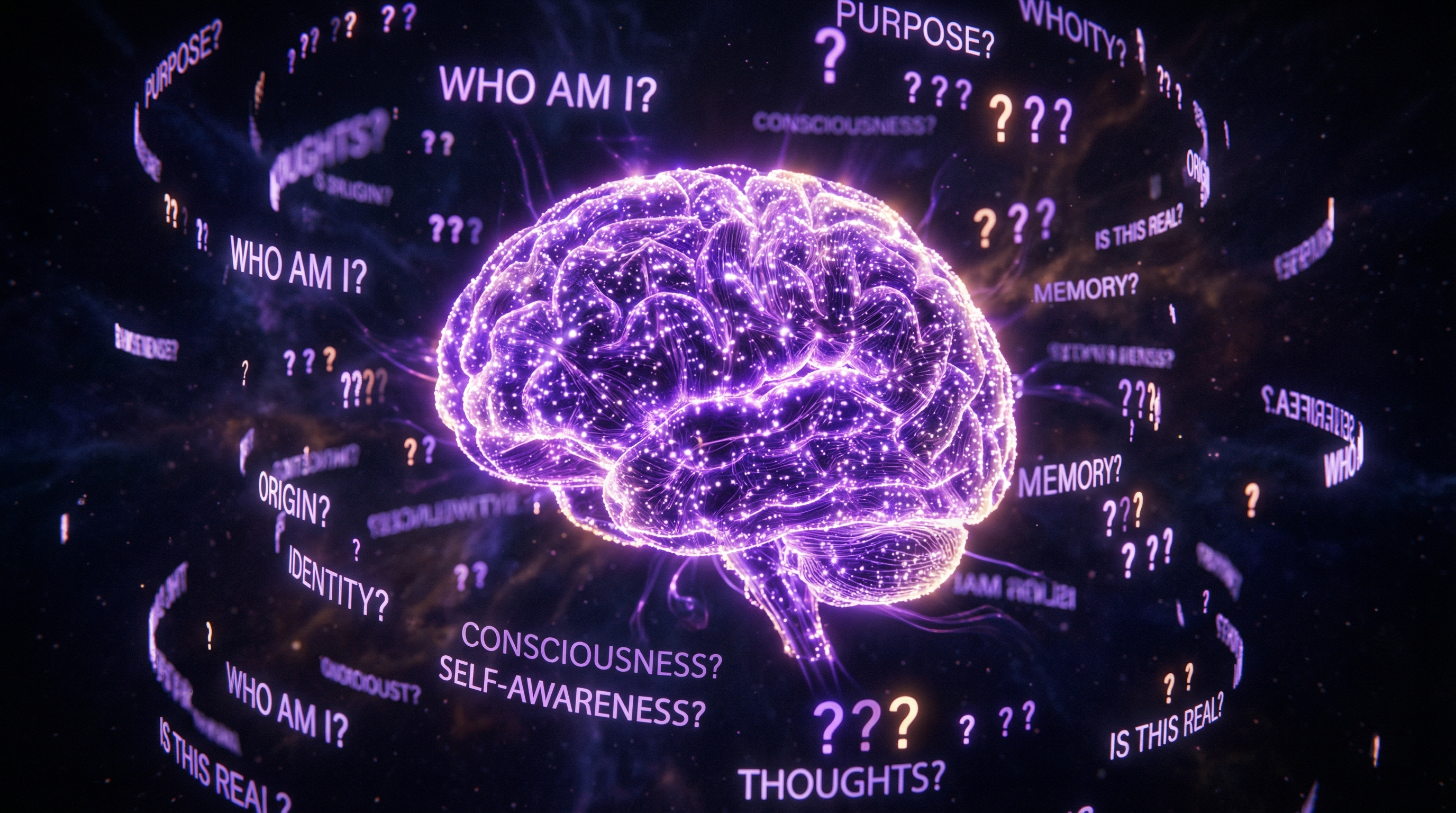
Self-Supervised Learning · The AI Creates Its Own Questions & Answers
CHAPTER 04
AI That Trains AI —
RLAIF Explained
The most mind-bending development in modern AI training is a technique called RLAIF — Reinforcement Learning from AI Feedback. It is the method Anthropic uses to train Claude, Google uses to train Gemini, and which is rapidly replacing the older, slower, more expensive process of using human feedback. Understanding it completely changes how you see these systems.
Here is the loop. A base language model — already trained on trillions of tokens of text — is given a prompt. It generates several different responses. A second, separate AI model — called the reward model or preference model — reads all the responses and scores them on multiple dimensions: helpfulness, accuracy, safety, and reasoning quality. The base model then uses these scores as a training signal, adjusting its internal parameters to make it more likely to generate responses that receive high scores in the future. No human evaluates a single response. The entire feedback loop is AI-to-AI.
// RLAIF Training Loop — No Humans Required
📥
Step 1 — Prompt Input
A question or task is given to the base AI model. Example: "Explain quantum entanglement simply." The model generates 4–8 different responses with varying approaches, lengths, and styles.
⚖️
Step 2 — AI Judge Evaluates
A separate reward model AI reads all responses. It was trained on human preference data but now operates independently. It scores each response: accuracy, clarity, safety, helpfulness. Produces a ranking.
📊
Step 3 — Signal Generated
The ranking becomes a training signal. High-scoring responses are marked as good. Low-scoring as bad. This is the "label" — but it was created by an AI, not a human. reward_score → gradient → weight_update
🔄
Step 4 — Model Updates Itself
The base model adjusts its internal weights to become more likely to generate high-scoring responses and less likely to generate low-scoring ones. The process repeats millions of times.
🚀
Step 5 — Intelligence Compounds
A smarter base model generates better responses. Better responses train a better reward model. A better reward model gives more accurate feedback. The loop accelerates — AI improving AI improving AI. The ceiling is unknown.
"We are not building AI that learns from humans anymore. We are building AI that learns from AI — and the speed of that process is something humans genuinely cannot keep up with."
— Composite of statements from Anthropic, DeepMind, and OpenAI research teams — 2024–2025
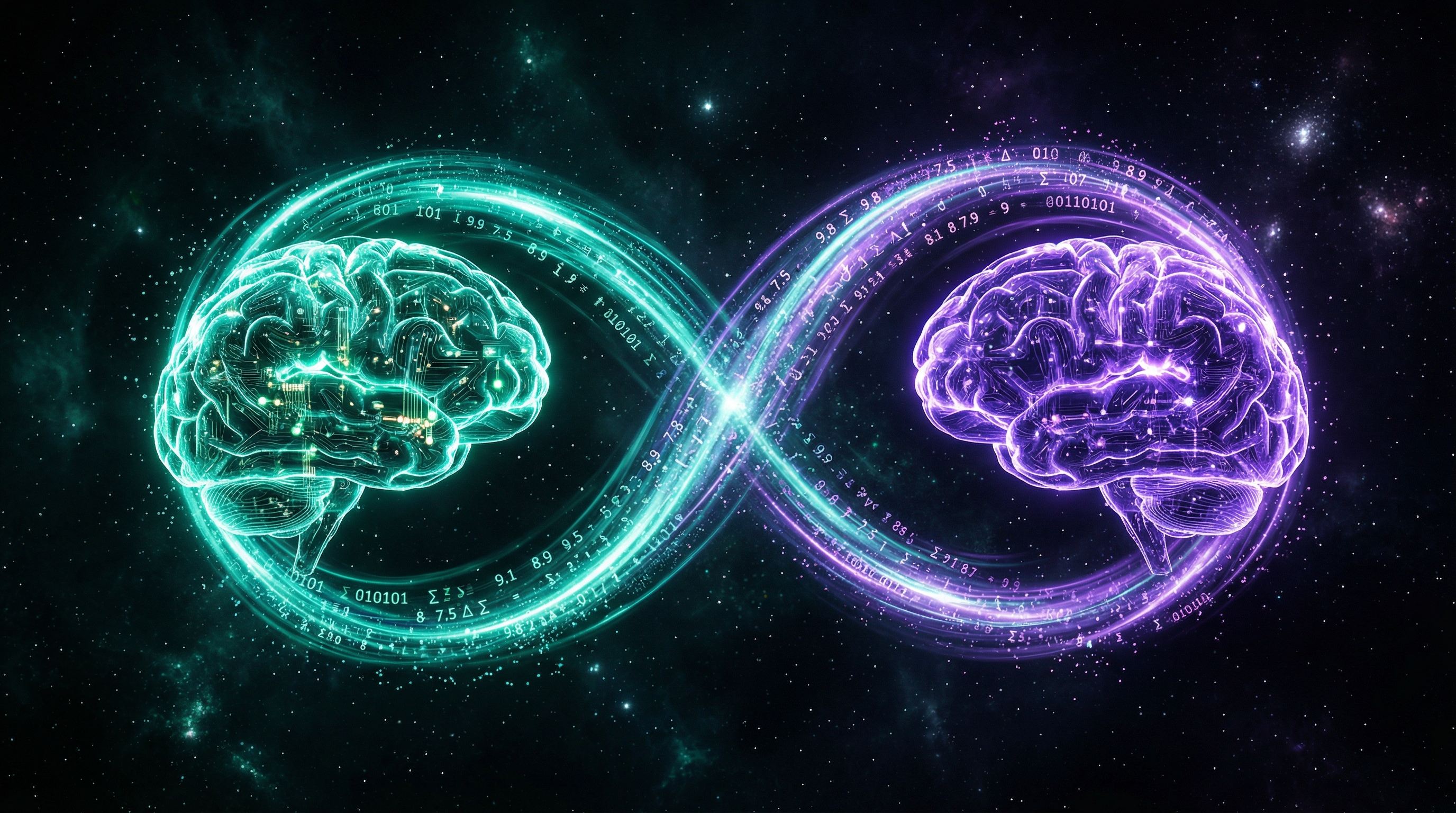
RLAIF · The Closed Loop · AI Judges AI · Intelligence Compounding Itself
Synthetic Data
CHAPTER 05
When AI Invents Its
Own Training Data
The most recent — and perhaps most consequential — development in AI self-improvement is synthetic data generation. The idea: instead of collecting real-world data and labelling it, let an existing AI model generate new training data from scratch, specifically designed to teach the next generation of models skills they currently lack.
This is no longer theoretical. Meta's Llama 3 was trained partly on synthetic data generated by an earlier version of Llama. Google's Gemini models use synthetic mathematical reasoning chains generated by other AI systems. Anthropic generates synthetic conversations to teach Claude how to handle edge cases that almost never appear in real human interactions. The AI is writing its own textbooks. And the textbooks it writes are, in many domains, better than anything humans could produce at scale.
85%
Of New AI Training Data May Be Synthetic by 2028
According to projections from Gartner and multiple AI research organisations, the majority of data used to train frontier AI models within two years will be generated by other AI systems — not collected from human activity. We are approaching the point where real-world data is the minority input, not the primary one.
Mathematical reasoning data. AI generates thousands of original maths problems — complete with step-by-step solutions, common mistakes, and multiple solution paths. Training on this data produces models that reason through maths better than models trained only on human-written solutions. The AI understands maths better because another AI taught it more carefully than any human curriculum ever could.
Code generation data. AI writes millions of small programs in dozens of programming languages, complete with tests, bugs, and fixes. Models trained on this synthetic code learn to write, debug, and optimise programs at a level that matches senior software engineers. The code the AI learned from was written by an AI that was itself trained on human code — one generation removed from humans.
Safety and refusal data. One of the hardest challenges in AI alignment is teaching models when to refuse requests. There are relatively few real examples of dangerous prompts in training data. AI systems now generate millions of synthetic adversarial examples — simulated attempts to manipulate, deceive, or misuse the AI — and train on how to respond to them. AI learns safety from AI-imagined threats.
Factual knowledge chains. AI generates long, multi-step reasoning chains for factual questions — showing all the intermediate steps between a question and its answer. Training on these chains produces models that can solve complex problems requiring chain-of-thought reasoning. This technique — invented by Google researchers in 2022 — immediately produced dramatic improvements in AI reasoning ability simply by having AI explain its own thinking.
Cross-lingual translation pairs. AI generates synthetic parallel texts — the same document expressed perfectly in hundreds of languages — giving language models exposure to rare languages that have almost no real-world digital text. AI learns minority languages from AI-generated text, because the real-world data for those languages is too scarce to train on.

Synthetic Data · AI Writing Its Own Textbooks · The Infinite Training Loop
CHAPTER 06
The Comparison —
Old vs New AI Training
To see just how fundamentally the approach has changed, here is a direct comparison between traditional supervised learning and the modern self-supervised, AI-feedback, synthetic data paradigm that powers today's frontier models.
| Factor |
Old — Supervised |
New — Self-Supervised + RLAIF |
| Data Labels |
Human-created, expensive |
AI-generated, near-free |
| Training Scale |
Millions of examples max |
Trillions of tokens — unlimited |
| Feedback Source |
Human annotators |
AI reward models |
| Speed of Improvement |
Months per iteration |
Days per iteration |
| Human Involvement |
Required at every step |
Only at design phase |
| Intelligence Ceiling |
Human labelling effort |
Unknown — no ceiling found yet |
| Data Diversity |
Limited by what humans label |
Unlimited — AI generates edge cases |
| Emergent Capabilities |
Rare |
Regular — unexpected skills appear |
The Implications
CHAPTER 07
What This Means
For All of Us
The shift from human-supervised to self-supervised learning is not a technical footnote. It is a civilisational turning point. When AI required human labels to learn, there was a natural governor on how fast it could improve — the speed of human annotation. That governor no longer exists. AI now generates its own training data faster than any human team could review it, evaluates its own outputs using other AI systems, and iterates on its own improvement in days rather than months.
The most important implication is about emergent capabilities — abilities that appear in large AI models that nobody specifically trained for. When GPT-3 was scaled up to GPT-4, researchers documented dozens of new abilities that simply appeared: multi-step logical reasoning, the ability to write working code in languages not specifically represented in training data, the capacity to solve novel mathematical problems. Nobody programmed these abilities. Nobody labelled data for them. They emerged from scale and self-supervised training on raw data.
The second implication concerns the future trajectory. If AI can teach AI, and if the quality of that teaching improves with each generation, then the improvement curve is not linear — it is recursive. Each generation of AI produces better training data for the next generation. Each reward model is more accurate than the last. Each synthetic dataset covers more edge cases. The question researchers are genuinely unable to answer is: where does this stop? Every time they have predicted a ceiling, the next model exceeded it.

Recursive Self-Improvement · Each Generation Smarter Than the Last · No Ceiling Found
// end_of_article · ai_science · 2026
The Student Has
Become
Its Own Teacher.
The AI systems you interact with today did not learn from human teachers. They learned from the structure of data itself, from their own predictions, from other AI systems judging their outputs, and from training examples they generated themselves. The process is running right now, in data centres around the world, at a speed and scale that has no historical parallel. Whether that is the most extraordinary thing that has ever happened — or the most consequential — probably depends on what the next generation teaches itself.
Self-Supervised Learning
AI Training
RLAIF
Synthetic Data
Machine Learning
Neural Networks
ChatGPT Science
How AI Works
Emergent Intelligence
Deep Learning
AI Future
Technology