Executive Summary
Scientists warn that global warming has already triggered the first of several catastrophic climate tipping points. According to a new report by 160 scientists, the world's coral reefs – the "rainforests of the sea" – have been pushed beyond recovery. Record ocean heatwaves have now bleached approximately 84% of reefs worldwide, and experts agree "extensive reefs as we know them will be lost" unless warming is rapidly reversed. This article, drawing on Guardian, CNN and scientific sources, explains the key findings, compares relevant metrics, and outlines the potential domino effects including thawing permafrost, Amazon dieback, and ocean current collapse.
The New Reality We've Entered
A landmark report by 160 climate scientists has arrived at a sobering conclusion: "The world has entered a new reality" as humans push coral reefs past the brink of collapse. What was once a theoretical warning has become measured fact – the first global climate tipping point has been reached, threatening food supplies and nearly $10 trillion of coastal economies.
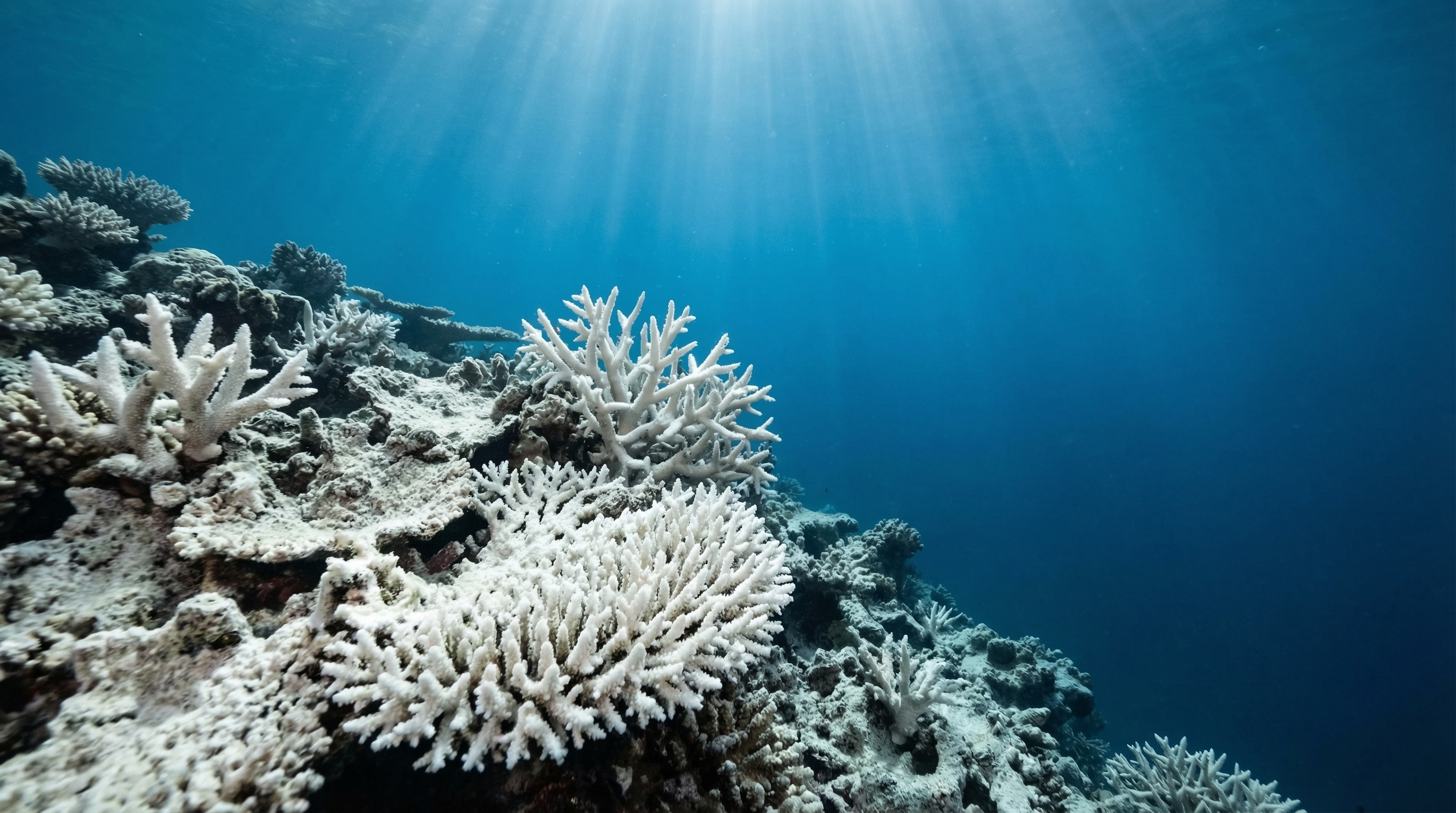
Imagine the world's most vibrant underwater ecosystems turned ghost-white. This haunting transformation is now happening on 80% of the planet's reefs due to record heat. Scientists say this catastrophic shift demonstrates that we've triggered irreversible climate feedbacks – changes that will perpetuate themselves even if we take action today.
Key Finding: The UN's latest climate warning is dire: "We have now pushed coral reefs beyond what they can cope with," said WWF scientist Mike Barrett. This marks Earth's first confirmed overshoot of a climate tipping point.
Global Climate Tipping: The Evidence
The new Global Tipping Points Report 2025, compiled by 160 scientists from 23 countries, identifies warm-water coral reefs as the first Earth system to hit a climate tipping point. The science is unambiguous: reefs need temperatures held below approximately 1.2°C of warming (relative to pre-industrial levels) to survive. We have already reached approximately 1.4°C.
Oceans are now at record heat levels, causing the worst bleaching on record – 84% of reefs have recently experienced mass bleaching events. WWF chief scientist Mike Barrett warns that "we have now pushed coral reefs beyond what they can cope with" – essentially past any chance of meaningful recovery. This means extensive reef systems will be lost unless emissions are slashed immediately.
Key Data: Climate Tipping Metrics
| Indicator / Claim |
Value / Projection |
Source |
| Current global warming (rise) |
~1.4°C above pre-industrial |
Guardian (2025 report) |
| Coral reef tipping threshold |
~1.2°C (beyond which reefs collapse) |
Guardian (report summary) |
| Percentage of reefs bleached (2023) |
~84% worldwide |
Earth.org (report synthesis) |
| Projected warming by 2100 (current pledges) |
2.6–3.1°C |
UN/IPCC pathways (2025) |
| AMOC collapse risk timeframe |
Possible within decades (possibly this generation) |
CNN quoting scientists |
| Economic value of reefs |
~$9.9 trillion (annual ecosystem services) |
Earth.org (GCRMN data) |
These figures highlight the extraordinary scale of the crisis. Coral reefs support 25% of all marine species despite covering less than 1% of the ocean floor. They provide approximately $10 trillion in ecosystem services annually, including coastal protection, fisheries, and tourism. Their loss would create cascading effects across both natural ecosystems and human economies.
According to the report, if current greenhouse gas pledges continue unchanged, the world is on track for 2.6–3.1°C of warming by 2100. More alarmingly, further tipping points are looming on the horizon. The Atlantic Meridional Overturning Circulation (AMOC) – the system of ocean currents that includes the Gulf Stream – is now considered at risk of collapse within the lifespan of today's children.
Scientific Consensus and Debate
Lead author Professor Tim Lenton from Exeter University emphasizes the gravity of the situation: "We are rapidly approaching multiple Earth system tipping points" with "devastating consequences." The CNN report quotes WWF's Barrett with stark clarity:
We have now pushed coral reefs beyond what they can cope with. Extensive reefs as we know them will be lost.
These claims are corroborated by multiple lines of evidence. Satellite data shows the extent of bleaching across global reef systems, while ocean temperature measurements have set consecutive records throughout 2023-2025. While some researchers note that certain coral species may demonstrate adaptation capacity, and isolated reef refugia might persist in specific locations, the overwhelming scientific consensus is clear: the scale of die-off is unprecedented in the historical record.
The United Nations and NOAA (National Oceanic and Atmospheric Administration) have issued warnings that almost all coral reefs face severe threats under current warming trajectories. This isn't speculation or modeling – it's observable reality unfolding in real-time across the world's tropical oceans.
Beyond Corals: The Domino Effect
The collapse of coral reef systems represents just the first domino in a potentially catastrophic sequence. The report warns of additional "cascading" failures across Earth's interconnected climate systems.
Ice Sheet Destabilization
Both the Greenland and Antarctic ice sheets are described as "looking perilously close" to their own tipping points. These massive ice formations contain enough frozen water to raise global sea levels by meters. Recent observations show accelerating ice loss, with meltwater flowing into oceans at rates faster than predicted by earlier models.
Amazon Rainforest Transition
The Amazon rainforest, often called "the lungs of the Earth," faces pressures from both deforestation and intensifying drought. Scientists warn it may flip to a savannah-like state within decades. This transition would not only eliminate a crucial carbon sink but could release vast amounts of stored carbon back into the atmosphere, further accelerating warming.
Ocean Circulation Collapse
Perhaps most concerning is the potential disruption of the Atlantic Meridional Overturning Circulation (AMOC), commonly known as the Gulf Stream. This system of ocean currents regulates climate across the Northern Hemisphere, bringing warmth to Europe and influencing weather patterns globally. The report indicates this system could collapse "within the lifetime of people born today," causing extreme regional cooling in some areas and intensified heatwaves in others.
⚠️ The Danger Zone
Earth is now firmly in the "danger zone" of climate change. As Professor Lenton notes, crossing these thresholds would "shape the Earth system for a very long time" – potentially thousands of years. Current policies and international agreements were not designed for such abrupt, nonlinear shifts in planetary systems.
Implications for Humanity
The implications of crossing this first tipping point extend far beyond marine biology. Coral reef loss will directly impact food security and livelihoods for hundreds of millions of people in coastal communities worldwide. Reefs provide critical protein sources through fisheries and protect coastlines from storm surge and erosion.
Economic Consequences
Countries heavily dependent on reef ecosystems face staggering costs. Australia's Great Barrier Reef alone supports 64,000 jobs and contributes $6.4 billion annually to the national economy. Indonesia, the Philippines, and numerous island nations throughout the Pacific and Caribbean face similar or greater relative impacts. The loss of reef tourism, fisheries, and coastal protection services will require massive economic restructuring.
Interconnected Crisis
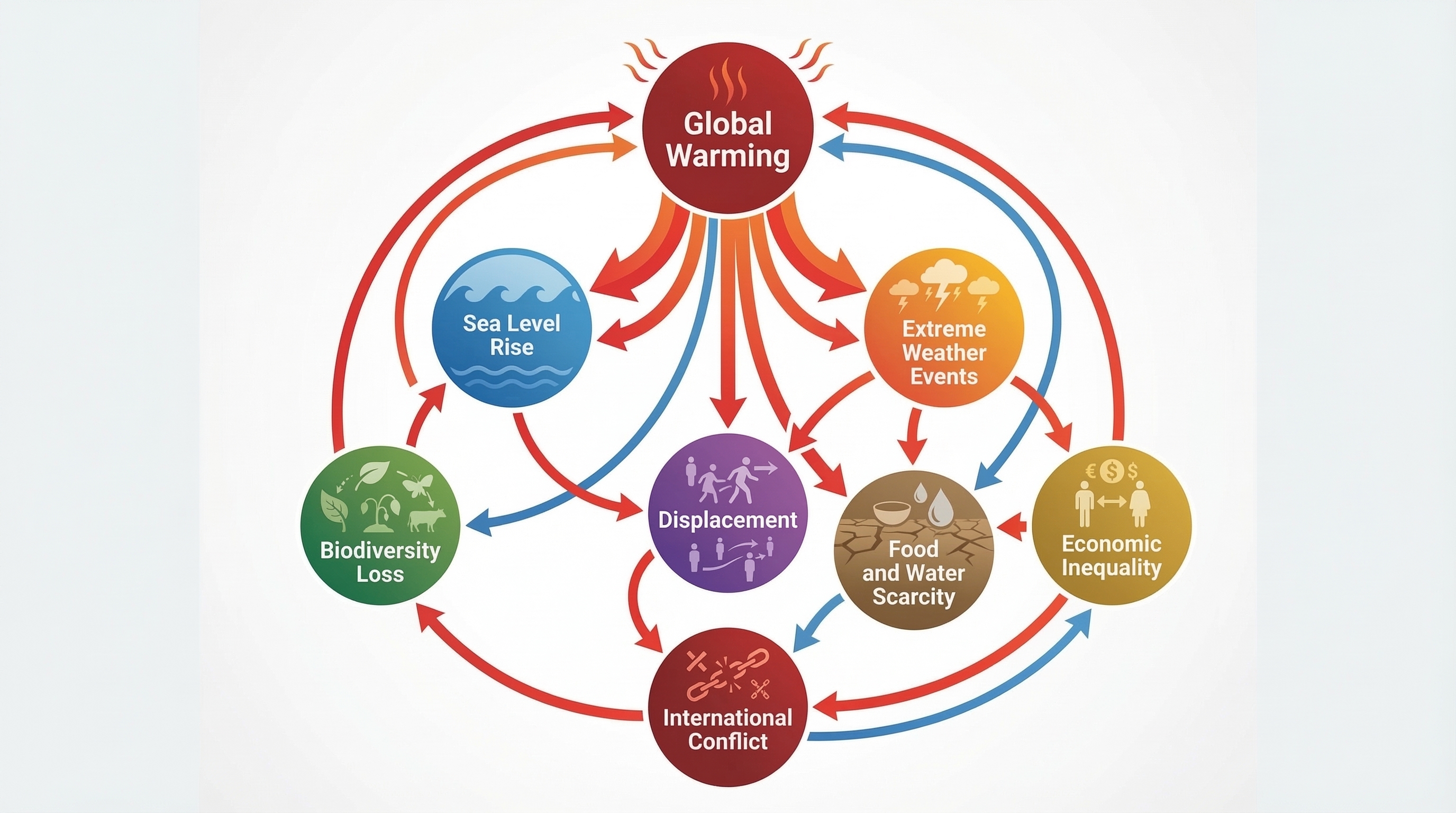
The cascading impacts diagram illustrates how climate-driven changes create feedback loops through human systems. Sea-level rise and extreme weather events drive displacement and migration. Resource scarcity – particularly water and arable land – increases competition and conflict potential. Biodiversity loss diminishes ecosystem services that human societies depend upon. These are not isolated problems but interconnected crises that compound one another.
Economic analyses suggest climate damages could reduce global GDP by several percentage points by mid-century. However, these projections often struggle to capture the full scope of tipping point dynamics. Once triggered, these changes become self-reinforcing, making cost-benefit calculations based on gradual warming scenarios increasingly obsolete.
A Window Still Exists
This story is sensational in scope, yet firmly grounded in peer-reviewed science. While the language is urgent, it reflects the actual findings of experts and official bodies including the IPCC, United Nations, and NOAA. These institutions concur that human activity has become the dominant driver of Earth's climate system.
Some researchers maintain that narrow windows of opportunity still exist. Aggressive protection of reef refugia – locations where conditions might remain marginally suitable – combined with dramatic emission reductions could preserve remnant ecosystems. However, the overriding scientific message is clear and urgent: the "point of no return" for coral reefs as we've known them has arrived. This marks the first time a global climate system has been pushed past its recovery threshold.
This is precisely why major media outlets worldwide – from The Guardian to CNN to the BBC – are providing prominent coverage to these findings. The tipping point is not theoretical. It is not a computer model prediction. It is happening now, measured and documented by scientists across the globe.
The Path Forward
Understanding that we've crossed this threshold doesn't mean abandoning hope – it means recognizing reality clearly enough to respond appropriately. The measures required are substantial: rapid decarbonization of global energy systems, protection and restoration of remaining natural carbon sinks, development of carbon removal technologies, and adaptation planning for impacts already locked in.
International cooperation on climate action takes on new urgency when viewed through the lens of tipping points. Unlike gradual warming scenarios where adaptation might keep pace with changes, tipping point dynamics can create rapid shifts that overwhelm adaptive capacity. The cascading nature of these systems means that preventing the next tipping point becomes exponentially more important than it was before the first one fell.
For individuals, communities, and nations, the message is consistent: the time for incremental responses has passed. The Earth system is demonstrating through observable, measurable changes that we are operating beyond safe boundaries. How we respond to this first tipping point may well determine whether it remains isolated or triggers the cascade that scientists have long warned against.
Primary Sources & References
- Global Tipping Points Report 2025 – International collaboration of 160 scientists from 23 countries assessing climate tipping points and their implications
- CNN/CNN Newsource - "The planet has entered a 'new reality' as it hits its first climate tipping point, landmark report finds" - Full Report
- The Guardian - "Planet's first catastrophic climate tipping point reached, report says, with coral reefs facing 'widespread dieback'" - Read Analysis
- Earth.org - "First Tipping Point Reached As Mass Coral Reef Die-Off Underway" - View Data
- PNAS (Proceedings of the National Academy of Sciences) - Climate systems analysis and cascading failure models - Diagram Source
- Global Coral Reef Monitoring Network (GCRMN) - Status reports on global reef health, bleaching events, and ecosystem services valuation
- IPCC (Intergovernmental Panel on Climate Change) - Assessment reports on temperature projections and climate system tipping points (2025 pathways)
- NOAA (National Oceanic and Atmospheric Administration) & UK Met Office - Ocean temperature monitoring data and coral bleaching event documentation (2023-2025)
- WWF (World Wildlife Fund) - Expert analysis and statements on reef ecosystem collapse from chief scientist Mike Barrett
- United Nations Environment Programme - Climate tipping point assessments and global warming impact projections
All sources consulted are peer-reviewed scientific publications, official governmental and intergovernmental reports, or established news organizations with rigorous editorial standards. Temperature data, bleaching percentages, and economic valuations have been cross-referenced across multiple authoritative sources.