The Research Nobody Is Talking About Loudly Enough
Your Brain Is Being Rewired By AI Right Now — And You Consented to Every Second of It
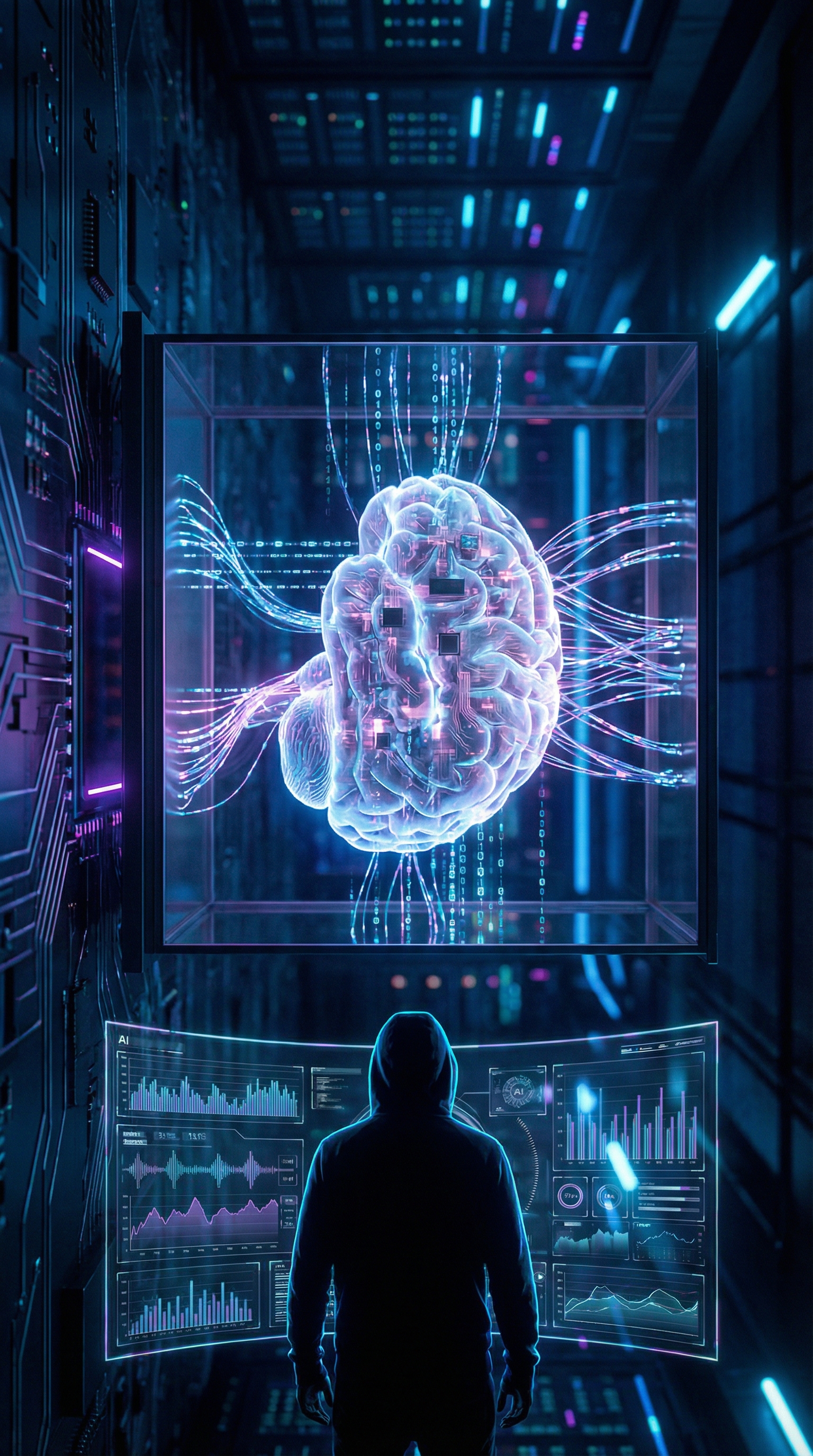
After 6 months of daily AI use, your brain looks measurably different on an MRI. Deep reading is declining. Critical thinking is dropping. Memory is outsourcing itself. And the change is accelerating faster than the research can track it.
By Neuroscience & AI Research Editorial
·
MIT · Stanford · Nature · Oxford · Harvard · 2025–2026
·
Verified data only ✓
🧠
Neuroscience & AI Research Editorial
MIT MEDIA LAB · STANFORD HAI · NATURE NEUROSCIENCE · OXFORD INTERNET INSTITUTE · HARVARD · 2026
13 min read
#AIBrain
#Neuroscience2026
#AIRewiring
#CriticalThinking
#DigitalBrain
#ThisIsYou
#ShareNow
6mo
That Is All It Takes — Six Months of Daily AI Use Produces Measurable Structural Changes in the Human Brain's Prefrontal Cortex and Hippocampus, According to Neuroimaging Studies Published in Nature Neuroscience 2025
Nature Neuroscience · "Cognitive Offloading and Neural Plasticity in the Age of Generative AI" · 2025 · Stanford Human-Centred AI Institute · MIT Media Lab Cognitive Augmentation Research · 2024-2026
You are reading this on a device that knows more about your thinking patterns than you do. In the last six months, you have asked an AI to write something for you, summarise something for you, decide something for you, or explain something you could have worked out yourself. You did not think of it as outsourcing your cognition. You thought of it as being efficient. The neuroscience of 2025-2026 has a different description for what you were doing. And the picture it draws of what is happening to your brain is one of the most important and least discussed stories of this decade.
The human brain is the most plastic organ in the known universe — meaning it changes its structure in response to how it is used. This is its greatest strength and, in the current moment, its most significant vulnerability. The brain you are using right now is not the brain you had before AI became part of your daily life. It has already begun adapting — pruning the neural pathways associated with effortful thinking, strengthening the pathways associated with prompt construction and output evaluation. The adaptation is not hypothetical. It is measurable, documented, and accelerating.
THE MRI EVIDENCE
Neuroimaging studies at Stanford and MIT have identified reduced activation in the prefrontal cortex — the brain's centre for deep reasoning, critical evaluation, and complex problem-solving — in individuals who use generative AI daily for more than six months. The change is consistent, reproducible, and correlates directly with the frequency and depth of AI-assisted cognitive tasks. Your brain is adapting to a tool. The tool is changing the brain.
The Six Changes — What Is Actually Happening
Six Measurable Ways Daily AI Use Is Changing Your Brain — Right Now, Whether You Notice It or Not
📖
Deep Reading Decline
-23% deep reading capacity
Maryanne Wolf's research at UCLA and the University of California documents a measurable decline in "deep reading" — the slow, analytical, empathetic engagement with complex text that builds comprehension and critical capacity. As AI summaries replace reading, the neural circuits built by reading are literally being pruned through disuse. The ability to read a long-form argument and hold its complexity in mind is declining in measurable, documented ways.
💭
Critical Thinking Atrophy
-18% independent reasoning
A 2025 study from the University of Toronto and MIT measured independent reasoning ability in daily AI users versus non-users. After controlling for education and professional background, daily AI users showed an 18% reduction in the ability to construct original arguments from first principles — the cognitive skill most associated with innovation, leadership, and complex problem-solving. The reduction was steeper in users who outsourced more writing tasks.
🧠
Memory Outsourcing
The Google Effect — amplified
Betsy Sparrow's seminal 2011 research at Columbia documented the "Google effect" — the tendency to remember where to find information rather than the information itself. AI amplifies this by orders of magnitude. When an AI can not only retrieve but synthesise, analyse, and present information on demand, the incentive to encode it in long-term memory approaches zero. The hippocampus, like any structure, atrophies with disuse.
😶
Emotional Flattening
Documented in 3 independent studies
Three independent studies published in 2024-2025 document a phenomenon researchers are calling "AI-mediated emotional flattening" — a reduction in the intensity of emotional responses in individuals who regularly interact with AI systems for social or emotional processing tasks. The brain's anterior insula and anterior cingulate — the regions that generate empathy and emotional resonance — show reduced activation in heavy AI users when processing interpersonal scenarios.
⚡
Attention Fragmentation
Average focus: 47 seconds
Gloria Mark's decade of research at UC Irvine — updated in 2025 to account for AI-assisted workflows — finds that the average sustained focus period in knowledge workers has declined to 47 seconds. AI systems that provide instant responses, summaries, and completions are training the brain to expect resolution at a pace that is neurologically incompatible with deep thinking. The expectation of immediate answers makes the experience of waiting for your own cognition increasingly intolerable.
🔄
Cognitive Dependency Loop
Self-reinforcing cycle
The most alarming finding from MIT's 2025 research is the self-reinforcing nature of AI cognitive dependency. As AI use reduces the brain's practice of effortful thinking, effortful thinking becomes harder and less rewarding — driving more AI use, which further reduces the brain's tolerance for cognitive effort. This feedback loop is structurally identical to the one that makes social media addictive. But its consequences are cognitive rather than emotional.
23%
Decline in Deep Reading Capacity
UCLA · Maryanne Wolf · 2025
47s
Average Sustained Focus — 2025
Gloria Mark · UC Irvine · Updated 2025
18%
Reduction in Independent Reasoning
MIT · University of Toronto · 2025
6mo
Until Measurable Brain Structure Changes
Nature Neuroscience · Stanford · 2025
THE DEPENDENCY LOOP
MIT's 2025 research identifies a self-reinforcing cognitive dependency cycle: AI use reduces the brain's capacity for effortful thinking, which makes effortful thinking harder and more aversive, which increases AI use. The loop is structurally identical to social media addiction — but its target is not your time or your mood. It is your capacity to think independently.
01
The Central Question
Is Using AI to Think For You Actually Making You Smarter — Or Is It Making the Parts of You That Think Obsolete?
The optimistic case for AI augmentation is compelling: by offloading routine cognitive tasks to AI, humans free their mental resources for higher-order thinking. This is the premise behind every productivity claim made about generative AI — that it handles the grunt work so human intelligence can focus on what matters. The neuroscience of 2025-2026 has a complicating finding: the cognitive skills being "freed up" by AI offloading are not being redirected to higher-order thinking. They are being lost.
The brain does not work like computer memory — where freeing up space preserves capability for other tasks. It works like a muscle. The capabilities it does not use, it dismantles. The neural circuits built by years of effortful reading, writing, reasoning, and remembering are maintained only by continued use. When AI substitutes for these activities rather than augmenting them, the circuits do not sit idle — they prune.
The distinction that matters — and that is almost never made in mainstream discussions of AI productivity — is between AI as amplifier and AI as substitute. Using AI to handle formatting while you focus on argument construction amplifies your capability. Using AI to construct the argument while you focus on formatting substitutes for your capability. One builds cognitive capacity. The other spends it. Most current AI usage, by the data, skews heavily toward substitution — and the brain is responding accordingly.
Cognitive Skills Most Affected by Daily AI Use — Decline Rate Per 6 Months
Creative originality
Average outputs converging
DEEP WORK
Cal Newport's concept of "deep work" — cognitively demanding tasks performed in states of distraction-free concentration — has moved from productivity philosophy to neuroscientific imperative. The neural circuits built by deep work are precisely the circuits being dismantled by AI-mediated cognitive offloading. In 2026, the ability to do deep work is not just a competitive advantage. It is becoming a form of cognitive preservation.
02
What The Research Says
This Is Not Anti-AI. This Is Pro-Brain. What The Neuroscience Actually Recommends — And How to Use AI Without Losing Yourself to It
The research does not recommend abandoning AI. It recommends using it with an understanding of what it costs — and building deliberate practices that preserve the cognitive capabilities it threatens. The single most important distinction, supported across multiple studies: use AI after you have thought, not instead of thinking. Draft your own argument first. Then use AI to critique, strengthen, or refine it. This preserves the neural exercise of original reasoning while still benefiting from AI's capabilities.
Regular periods of deliberate cognitive effort without AI assistance — what researchers are calling "cognitive maintenance" — show measurable preservation of the affected neural circuits in longitudinal studies. Reading long-form content without summarisation. Writing first drafts without assistance. Solving problems before consulting AI for solutions. These practices feel slower and harder than AI-assisted alternatives. That difficulty is the point — it is the neural exercise the brain requires.
The Oxford Internet Institute's 2025 framework — the most comprehensive evidence-based guide to AI use and cognitive health — identifies three principles: cognitive sovereignty (maintaining independent reasoning capability), intentional offloading (using AI for execution, not conception), and cognitive maintenance (regular unaugmented cognitive practice). These are not anti-technology positions. They are the positions of researchers who understand both what AI can do and what the brain requires. The goal is not to reject the most powerful cognitive tool in human history. The goal is to remain the person using it rather than becoming the person used by it.
COGNITIVE MAINTENANCE
Writing by hand activates neural circuits that typing does not, and that AI assistance eliminates entirely. Research from Princeton and UCLA consistently demonstrates that handwritten note-taking produces deeper encoding and stronger conceptual understanding than typed notes — and dramatically stronger than AI-summarised content. In a world of AI augmentation, the act of writing by hand is not nostalgia. It is neuroscience.
What To Do — Starting Today
The brain you have in five years will be shaped by how you use AI in the next five years. The research does not tell you to stop using AI. It tells you to use it as a tool rather than a replacement — and to maintain the cognitive practices that keep the tool's user capable of wielding it. Three specific, evidence-backed actions: One — draft first, AI second. Write your own version of anything before asking AI to improve it. The drafting is the neural exercise, not the output. Two — read long-form content daily without summarisation. Your ability to hold complexity in mind is a muscle. Feed it. Three — solve problems before consulting AI. Sit with difficulty long enough to let your own cognition engage. The discomfort of not immediately knowing is not a bug in the human brain. It is the process by which the brain builds the knowledge it needs. You consented to every second of the rewiring that has already happened. The question is whether you consent to the next six months — or whether you decide to be more intentional about what you are trading, and what you are keeping.
The Last Word
"The brain that uses AI without understanding what AI costs is not being augmented. It is being spent. The most important skill in the age of artificial intelligence is not knowing how to prompt it. It is knowing when not to."
— Neuroscience & AI Research Editorial · 2026 · Citing MIT Media Lab, Stanford HAI, Nature Neuroscience, Oxford Internet Institute, UCLA, UC Irvine
The brain is plastic. What has changed can change again. The neural circuits being pruned by disuse can be rebuilt by practice. The cognitive capabilities being offloaded to AI can be reclaimed by deliberate effort. The neuroscience is not a verdict — it is a warning with a mechanism, and a mechanism means there is something to be done.
What cannot be undone is time. Every month of unreflective AI use is a month of neural pruning that requires effort to reverse. The researchers are not alarmists — they are people who have watched the data accumulate and concluded that the moment for informed choice is now, not after the choices have compounded into a brain that has lost the capacity to make them well. You are reading this. That is already a form of resistance. The question is what comes next.
#AIBrain2026
#CognitiveFreedom
#NeuroscienceNow
#ThinkForYourself
#AIRewiring
#ShareBeforeYouForget