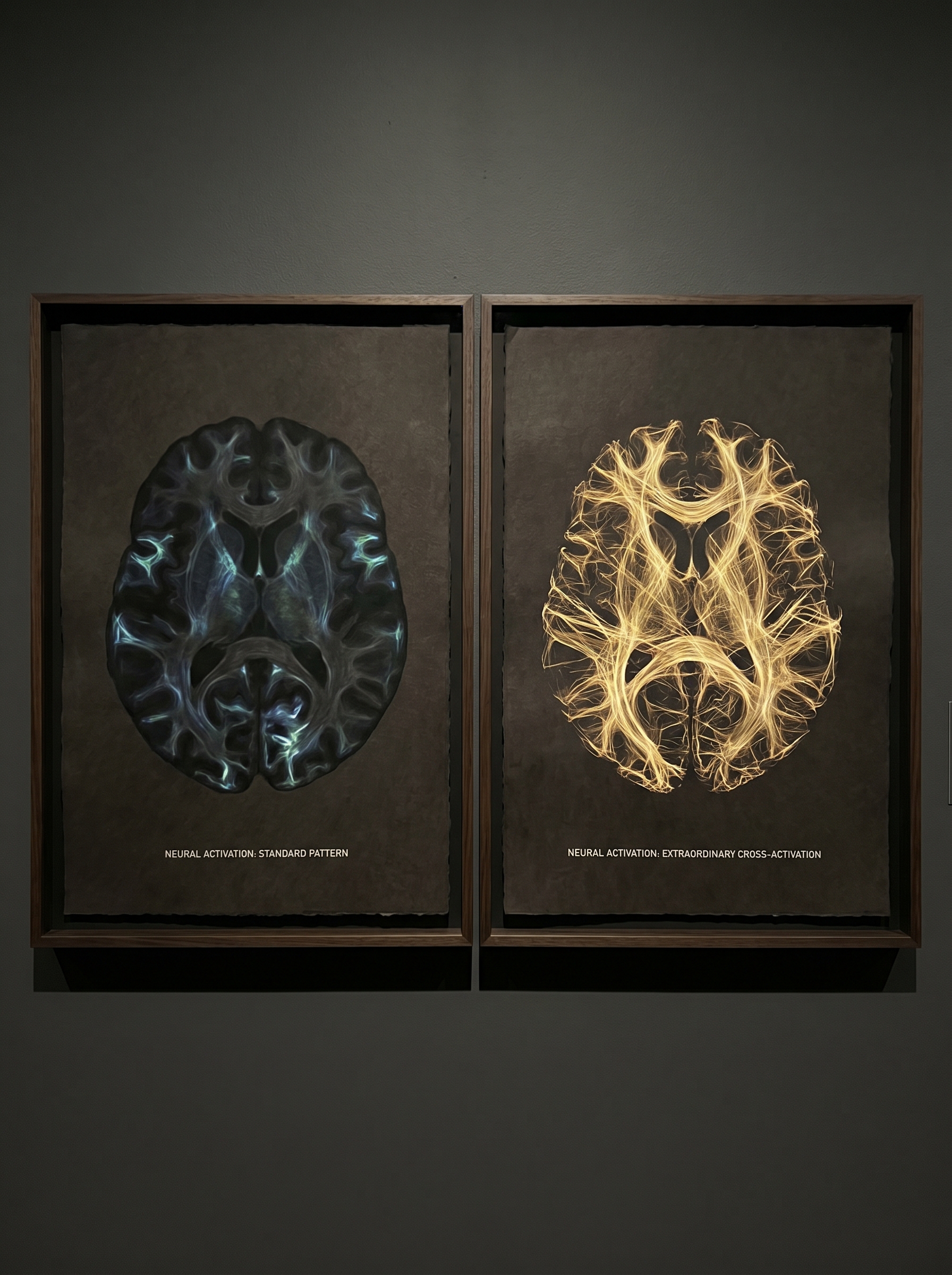
There is a specific feeling that some people carry their entire lives — the feeling of watching the world from a slightly different angle than everyone around them. Of noticing things others walk past. Of connecting ideas that seem unrelated to everyone else. Of asking questions that make people uncomfortable not because the questions are wrong, but because most people have never thought to ask them. Neuroscience now has a name for this. It has a measurable mechanism. And it explains why the people who carry it have always felt, simultaneously, like they see more clearly and fit in less easily.
This is not about intelligence in the conventional sense. The people described here are not necessarily the highest scorers on standardised tests — because standardised tests measure convergent thinking, the ability to find the single correct answer to a pre-defined question. What neuroscience has documented and measured is something different: divergent thinking, pattern recognition across unrelated domains, and the specific neural architecture that makes certain minds incapable of seeing the world in the simplified way most minds were built to process it.
Chapter 01 · The Science
What Their Brains Actually Do Differently
Same World · Different Operating System · What They See · Is Not What Everyone Else Sees · Both Are Looking
The neuroscience of divergent thinking has been studied systematically since the 1950s, when psychologist J.P. Guilford first distinguished it from convergent thinking. But the most revealing research has come from neuroimaging studies in the 2010s and 2020s, which showed something unexpected: highly divergent thinkers do not simply use more of their brain — they use it differently.
⚡
Neural Cross-Activation
Their Brain Connects Areas That Should Not Connect
In most brains, the Default Mode Network — active during imagination and self-reflection — and the Executive Control Network — active during focused problem-solving — are mutually suppressive. When one activates, the other quiets. In highly creative and divergent thinkers, both networks activate simultaneously, producing a cognitive state that combines imagination with analytical rigour in a way most brains cannot sustain.
🔗
Latent Inhibition
They Cannot Switch Off Irrelevant Information
Latent inhibition is the brain's mechanism for filtering out information it has previously decided is irrelevant. Most people have high latent inhibition — the brain efficiently ignores stimuli that have not been useful before. Divergent thinkers show significantly lower latent inhibition — their brains continue processing information that others' brains have already dismissed. This makes them simultaneously overwhelmed by the world and capable of noticing what others miss.
🌐
Remote Associations
They See Connections Across Unrelated Domains
The Remote Associates Test measures the ability to find connections between seemingly unrelated concepts. High scorers consistently show broader semantic networks — their brain's concept maps are more densely interconnected, with stronger links between domains that most people store in separate mental compartments. An idea in biology triggers associations in music. A pattern in architecture suggests a solution in economics.
😰
The Shadow Side
The Same Architecture That Creates — Also Overwhelms
Lower latent inhibition and cross-network activation come with a cost. The same neural architecture that produces extraordinary creative insight also produces higher rates of anxiety, sensory overwhelm, and the exhausting experience of a mind that cannot stop making connections. The creative gift and the emotional difficulty are not separate — they are the same neurological feature producing two different experiences.
🎯
Pattern Recognition
They See the Signal in the Noise Before Anyone Else
Studies at Northwestern University found that divergent thinkers show earlier and stronger neural responses to weakly associated stimuli — their brains detect pattern relevance before conscious awareness arrives. This is the neurological basis of intuition that turns out to be correct: the pattern was real, the brain detected it, and the conscious mind experienced it as a feeling rather than a thought.
Chapter 02 · The Experience
What It Feels Like — From the Inside
Two Brains · Same World · Different Maps · The Second Is Not Better · It Is Wired To See What The First Cannot
The experience of divergent thinking is not what most people imagine. It is not a constant state of creative euphoria. It is, more often, the specific experience of being in a conversation and seeing five additional dimensions of what is being said that nobody else appears to notice — and not knowing whether to mention them, because the last several times you did, the conversation stopped and everyone looked at you in a way that was not quite hostile, just confused.
It is reading a news story and immediately seeing the third-order consequences that the journalist, the experts, and the commenters are not discussing — and wondering whether you are seeing something real or simply being contrarian. It is the particular loneliness of a mind that finds the world endlessly interesting in ways that are difficult to share. And it is the specific frustration of systems — educational, professional, social — that are designed for the majority cognitive style and that treat the minority style as a problem to be corrected rather than a difference to be understood.
🔬 The Research — What the Data Shows
A 2019 study published in Proceedings of the National Academy of Sciences found that individuals scoring in the top percentiles for divergent thinking showed measurably different functional connectivity patterns across eleven distinct brain networks — not just in creative tasks, but during rest. The brain of a highly divergent thinker operates differently even when it is doing nothing. The architecture is structural, not situational. It does not switch on for creative tasks — it is always on.
Chapter 03 · The Signs
The 7 Specific Patterns — Do You Recognise Yourself?
Same Street · Same Moment · Different Eyes · What They See · Has Always Been There · Others Simply Do Not See It
"The intuitive mind is a sacred gift and the rational mind is a faithful servant. We have created a society that honours the servant and has forgotten the gift."
— Albert Einstein · Theoretical Physicist · A Mind That Connected What Others Thought Unrelated
You have always asked "why" one level deeper than the conversation expected. Not to be difficult. Not to show off. Because the answer given was genuinely not sufficient — you could see the next question that the answer implied, and it seemed obvious that it needed asking. The confusion on people's faces when you asked it was real. So was the question.
You connect ideas from completely different fields without trying to. A conversation about economics triggers a memory of something from evolutionary biology that seems relevant. A problem in your personal life has a structure identical to an engineering problem you read about once. These connections feel obvious to you and invisible to others in the room. This is not intelligence — it is the specific neural architecture of broad semantic networks making cross-domain pattern recognition automatic.
You have been described as "too sensitive" or "too intense" by people who meant it as criticism. The same nervous system that makes you notice what others miss also makes you feel what others filter out. The sensitivity and the perception are the same thing — one is the experience of the other. The people who called it a weakness were describing a feature they did not have and therefore could not evaluate accurately.
You find most conversations simultaneously too fast and too slow. Too fast because so much is being said implicitly that you are tracking and nobody else seems to be. Too slow because the explicit content — the words actually being exchanged — is covering ground your mind has already processed and moved beyond. This is not arrogance. It is the specific experience of a mind processing at a different bandwidth than the conversation it is participating in.
You have always had the feeling that you are not quite from the same place as everyone around you. Not superiority — just difference. The world everyone else inhabits and navigates with apparent ease has always seemed to you to be running on rules that nobody explicitly stated and that you have spent your entire life reverse-engineering. Because you are not running on those rules. You are running on something else. Something that sees the rules themselves as objects to be examined rather than air to be breathed.
Your best thinking happens when you are doing something else. Shower thoughts, walking thoughts, the half-asleep insight that makes you reach for your phone to write something down. This is not procrastination — it is the Default Mode Network activating when the executive control demands are reduced, producing exactly the cross-network activation that divergent thinkers show in neuroimaging. Your brain does its most important work when you stop forcing it to work.
You have repeatedly been right about things before anyone else saw them — and repeatedly found this unremarkable while others found it inexplicable. The pattern was obvious. The conclusion was clear. The only unusual thing was that nobody else appeared to see it yet. This is the temporal experience of early pattern recognition — the neural detection happening ahead of the consensus awareness, producing the specific experience of seeing around corners that defines the most useful divergent minds.
What To Do With It
Chapter 04 · The Practice
What This Means — And What to Do Next
Ordinary Faces · Extraordinary Minds · The Expression Nobody Can Perform · Recognition Without Arrogance
top 1%
Score on Divergent Thinking Tests — The Rarest Cognitive Profile
Research consistently shows that high divergent thinking ability — the combination of broad semantic networks, low latent inhibition, and cross-network neural activation — appears in approximately 1–2% of any tested population. This is not 1% of geniuses. It is 1% of ordinary people who process reality through a different architecture. If you recognise yourself in these descriptions, you are not imagining it. The neuroscience has been measuring you for decades. It just did not tell you.
The most important thing this knowledge provides is not validation — though that is real and valuable. It is a framework for understanding why certain environments feel depleting and others feel energising, why certain relationships feel nourishing and others feel exhausting, and why the advice given to everyone — study this way, work this way, think this way — has never quite fitted the way your mind actually operates. The framework is not an excuse. It is a map.
A map is most useful when you have been lost. And the specific kind of lost that highly divergent thinkers experience — the sense of navigating by instruments that produce different readings than everyone else's — is one of the most disorienting experiences available to a human being who does not know the reason for the difference. Knowing the reason does not change the instruments. But it changes what you do with the readings they produce.